
Cases · 2026-10-12 · 5 min read
They could hear the deepfake. They just couldn't prove it.
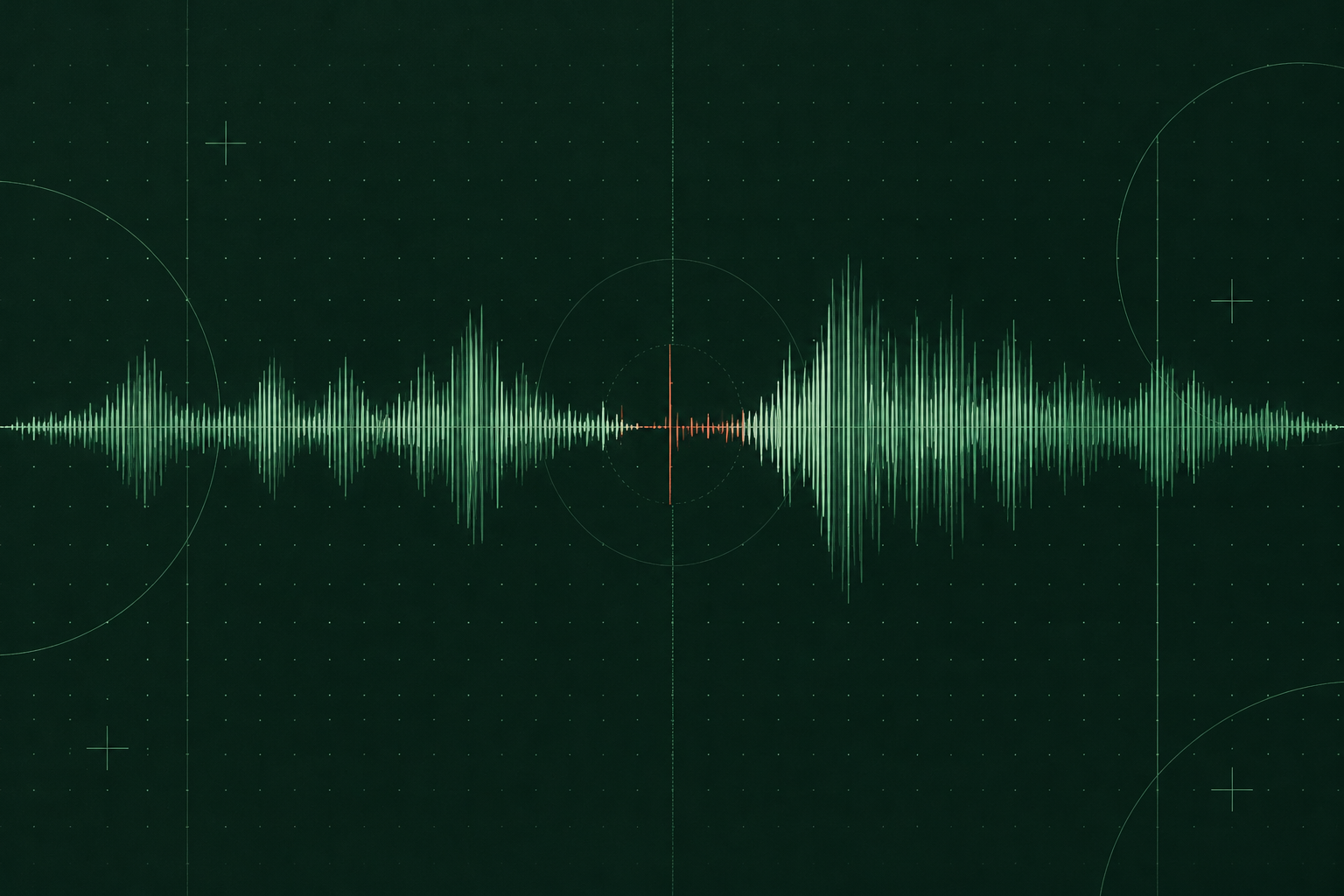
Legal counsel knew the audio was manipulated. Forensic analysis found the copied waveforms and artificial spikes. Yet the case turned on one question: could they show the recording had been changed after the fact?

When hearing isn't enough
Legal counsel listened to the audio file and heard the problem straight away. Parts of the recording sounded wrong: unnatural pauses, odd inflections, words that didn't quite fit. It was a deepfake, or at least manipulated, and they could tell.
But in court, being able to hear something isn't the same as being able to prove it. The question wasn't whether the recording sounded fake. The question was whether counsel could show it had been changed, and when.
That's the difference between suspicion and evidence. A car alarm going off tells you something might be wrong. A video recording of someone breaking the window shows what happened. In this case, what legal counsel needed wasn't just their own judgement. They needed forensic proof that the audio had been manipulated.
What the forensic analysis found
Resemble AI's forensic team ran the recording through spectral analysis [1]. A spectrogram turns sound into a visual map: time runs along the bottom, frequency up the side, and the intensity of each sound shows up as colour or brightness. It's a bit like sheet music, except it shows what actually happened rather than what was supposed to.
The analysis revealed two clear signs of manipulation. First, repeated waveform spikes at identical intervals, which don't occur in natural speech. Human conversation has variation: we breathe, pause and shift our tone. A pattern that repeats perfectly suggests something has been copied and pasted.
Second, segments of audio that were identical down to the waveform. When you record someone speaking the same sentence twice, the waveforms are never the same. Breathing, background noise and tiny shifts in pitch make each recording unique. Identical waveforms mean identical files, which in turn means one was copied from the other [1].
Together, the spectrogram and waveform analysis gave legal counsel what they needed: evidence that the recording had been manipulated, not just a hunch that it sounded wrong.
The evidence question
Deepfakes raise two separate questions. The first is whether content is fake. The second is whether you can prove it.
Forensic analysis answers the first question. It finds the seams, the repetitions and the artefacts that manipulation leaves behind. But it works backwards from a file you already have. It can tell you a recording has been changed. It can't tell you what the original sounded like, or even that there was an original.
The harder question is the second one. Say the other side produces an audio file and claims it's a recording of a conversation that took place six months ago. You listen to it and hear that it's been manipulated. Forensic analysis confirms it. But can you show what was actually said, or that the file wasn't the one made on the day?
That's where the evidence question lands. Proving something has been faked is one thing. Proving what it replaced, or that your version is the real one, is another.
A record made at the time
This is where a digital witness fits. The thing to seal is the recording at the moment it is made: a fingerprint of the audio file, the timestamp and, if relevant, the device or system that captured it. The recording itself stays with you. What gets sealed is proof that this file existed at this time, in this form.
When the file is later questioned, anyone you share it with can check the sealed fingerprint against the file. If they match, the file hasn't changed since it was sealed. Change a single bit and the fingerprints no longer match.
What it shows is that your recording is exactly what was captured on the day. What it doesn't show is that the recording is complete, that it's the only recording, or that the person in it said what you claim they said. Those are questions of interpretation and context. A digital witness deals with a narrower question: has this file changed since it was made?
In the case legal counsel handled, a sealed recording made at the time would have shifted the burden. Instead of trying to prove the other side's file had been manipulated, they could have shown their own file, sealed when it was captured, and left the other side to explain why the two didn't match.
Anyone you share the sealed recording with can run the check: calculate the fingerprint of the file they have and compare it with the sealed one. The check takes seconds and requires no special access. You can do it through the REST API, the SDK or the MCP server at WitniumChain. The first 2,000 witnesses a month are free, and the sealed fingerprint can be kept for as long as you need it.
How it would work
- At capture, the system takes a fingerprint of the audio file and seals it with the timestamp.
- The sealed fingerprint is stored separately from the file, which stays in your systems.
- When the recording is questioned, you share the file and the sealed fingerprint. The recipient calculates the fingerprint again and checks it against the sealed one.
What this means for you
If your organisation records calls, meetings or statements that might later be disputed, three questions are worth asking now:
- When a recording is made, does the system create a fingerprint of it at capture?
- Can you show, months later, that a file is the one made on a given day and that nobody has changed it since?
- If someone produces a manipulated version and claims it's the original, can you prove otherwise?
Forensic analysis is a powerful tool for finding manipulation. But it works best when you have your own record to compare against, made at the time and sealed in a way that any later change would show.
Deepfakes will keep getting better. The question isn't whether they can fool the ear. The question is whether, when it matters, you can prove what was actually said.
What to watch
Article 50 of the AI Act requires users to disclose when audio, images or video are AI-generated or manipulated, and the disclosure must be clear and distinguishable [2]. For high-risk AI systems, Article 12 requires automatic logging over the system's lifetime, which applies from 2 December 2027 for systems under Annex III [3].
Neither rule says how to protect a recording or a log from later manipulation. That question is left to the organisation keeping the record.
Sources
- [1]They could hear the deepfake. They just couldn't prove it. Forensic deepfake detection supporting legal cases, Resemble AI, 2024
- [2]Article 50: Transparency obligations for providers and users of certain AI systems, European Commission AI Act Service Desk, 2024
- [3]Timeline for the implementation of the EU AI Act, European Commission AI Act Service Desk, 2024