
Cases · 2026-10-12 · 5 min read
Deepfakes in divorce cases raise a question courts can't duck
When spouses submit AI-generated photos, messages or recordings as evidence, judges face a new problem: working out what is real without reliable tools to tell them.

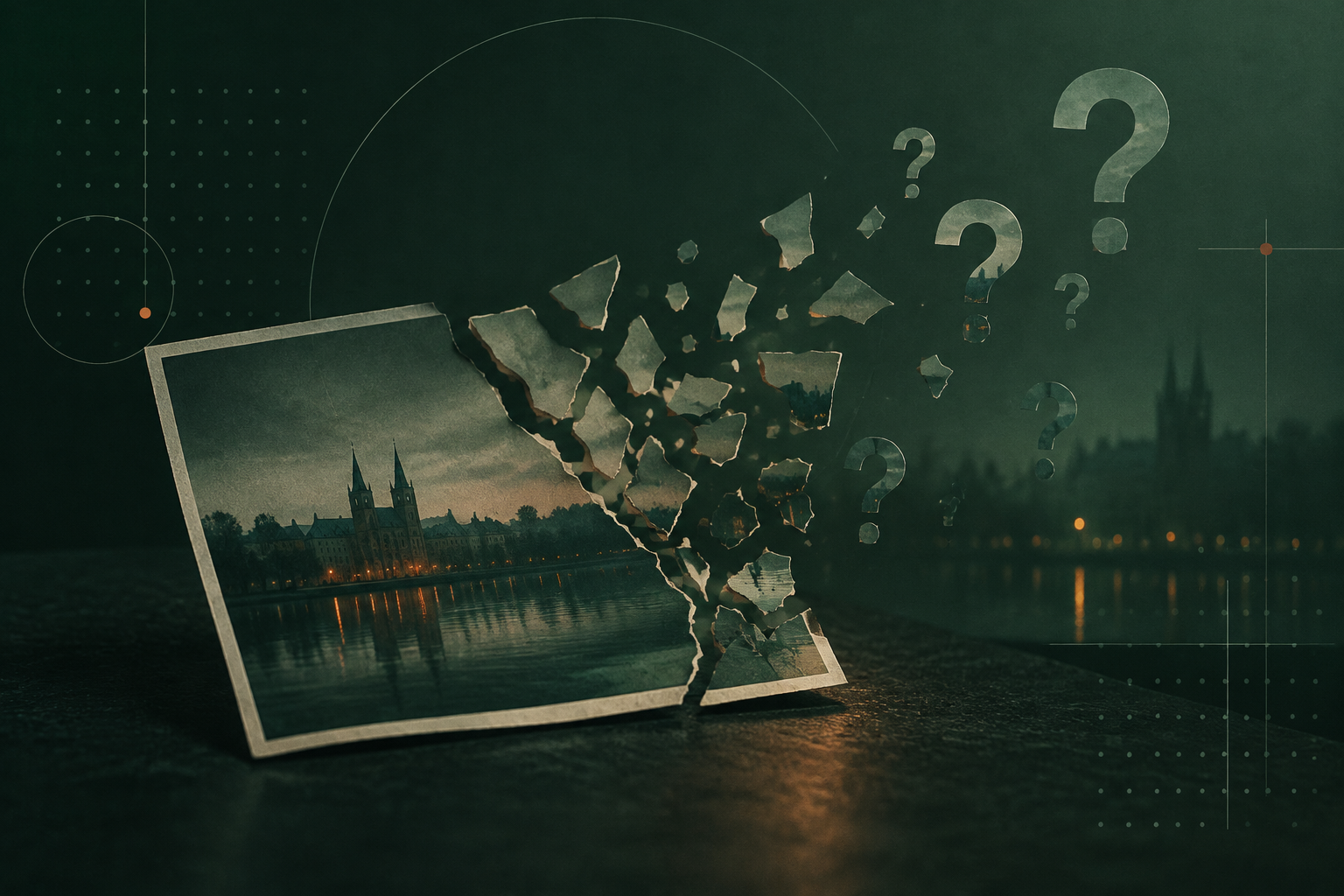
When the evidence itself is in question
A photo of a spouse with someone else. A recording of a threatening phone call. Messages arranging secret meetings. In a divorce case, evidence like that can decide custody, division of assets and financial support.
The problem now is that all of it can be faked, and the tools to do it are everywhere. Courts in England, the United States and elsewhere are seeing AI-generated photos, manipulated voice recordings and invented text exchanges submitted as evidence [1]. Judges have to work out what is real, often without technical help and with no settled test to rely on.
It is like handing someone a fifty-pound note and asking them to tell you, just by looking, whether it is real. They might spot something obviously wrong, but if it is a good fake, they are guessing.
What the law says about evidence
In Sweden, as in England, all evidence can be put before a court [2]. There is no list of what counts and what doesn't. Instead, judges assess each piece freely and decide how much weight to give it.
That works when the question is whether a witness is telling the truth. It is harder when the question is whether a photo or a recording has been manipulated, because the tools to check that are technical, expensive and not always available to a family court on a Tuesday morning.
Under Article 50 of the AI Act, people must as a rule be told when they are interacting with an AI, and anyone publishing AI-generated images, audio or video that looks real must mark it in a machine-readable way [3]. That applies from 2 August 2026. It will help in some cases, but it doesn't solve the problem when someone removes the marking, edits a file after it was created or submits something that predates the rule.
Metadata is easy to change
A photo's metadata, the information stored in the file about when and where it was taken, can be edited in seconds with free software. Exchangeable image file format, known as EXIF data, was never designed to be tamper-proof. It is useful if nobody has touched it, but once someone has reason to lie, it proves nothing.
Some camera apps and platforms are working on adding cryptographic signatures to images at capture, so that any later change would show [4]. That helps, but it depends on the sender using the right tool, and on the recipient being able to check the signature. In a contested divorce, neither side has much reason to hand over files that make their own case weaker.
What a digital witness can and can't do
Here, sealing a photo or a message at the moment it is captured gives the sender a record that can be checked later. A digital witness takes a fingerprint of the file and seals it on a chain where any change would show. The file itself never leaves the sender's device.
Say one party takes a photo on their phone. If the photo app seals it at that moment, anyone the sender shares it with can later calculate the fingerprint again and check it against the sealed one. If the file has been edited, even by one pixel, the fingerprints won't match.
That shows the file hasn't changed since it was sealed. It doesn't show that the photo depicts what the sender says it does, or that it wasn't staged. A sealed photo of someone at a hotel doesn't prove they were having an affair, just as an unsealed one doesn't prove they weren't. The difference is that the sealed version can't be quietly edited later to add or remove something.
In practice, sealing works like this. The sender's phone or app sends a fingerprint of the photo to WitniumChain through the REST API, the SDK or the MCP server, at the moment the photo is taken. The content stays on the phone. WitniumChain returns a witness ID. Later, anyone with the photo and the witness ID can check whether it matches. If one side's photo has a witness and the other side's version of the same scene doesn't, or if the fingerprints don't match, that tells the court something.
What it doesn't do is prove the photo is real in the first place. A staged deepfake image, sealed at the moment it is generated, will have a valid witness. The witness shows the file hasn't been edited since sealing, not that the content is genuine. That is still a question for the court, but at least it is a question about one fixed version, not about multiple versions that might have been changed along the way.
The first 2,000 witnesses a month are free. After that, it is a penny per witness.
How it would work
- At the moment a photo is taken or a message is sent, the app calculates a fingerprint and seals it.
- The fingerprint, not the content, is sent to WitniumChain, which returns a witness ID.
- Later, anyone with the file and the witness ID can recalculate the fingerprint and check it hasn't changed.
What this means for you
If you are a family lawyer, it is worth asking a client early on whether they have the original files for the evidence they want to rely on, and whether those files have been edited. If the other side submits a photo or a recording, ask for the metadata and, if it matters, whether the file has a cryptographic signature or a witness. Courts are still working out how to handle AI-generated evidence, and being able to show a file is unchanged since a known date gives it more weight than one that might have been edited.
If you build camera apps, messaging platforms or evidence-gathering tools, sealing at capture is worth considering. It costs almost nothing per user, and it means the evidence your users rely on can be checked.
If you are going through a divorce and you have photos, messages or recordings that matter, keep the originals and don't edit them. If someone accuses you of faking something, being able to show it hasn't changed since the day it was created is better than having to argue about it.
What to watch
From 2 August 2026, Article 50 of the AI Act requires AI-generated content that appears authentic to carry a machine-readable marking. That will help courts identify some manipulated evidence, but only if the marking is still there.
Several camera manufacturers and platforms are developing standards for signing images at capture, under the Coalition for Content Provenance and Authenticity. When that becomes widespread, courts will have a clearer way to tell whether a file has been edited. Until then, judges are doing their best with tools that weren't built for deepfakes.
Sources
- [1]How Could AI-Generated Evidence Affect a Divorce Case?, Thakkar Family Law, 2024
- [2]Rättegångsbalken 35 kap. 1 § (free assessment of evidence), Riksdagen, 1942
- [3]Article 50: Transparency obligations for certain AI systems, European Commission AI Act Service Desk, 2024
- [4]Coalition for Content Provenance and Authenticity, C2PA, 2024