
Ahead · 2026-10-23 · 4 min read
No One Owns the Fallout When an AI Agent Fails
More than half of executives admit they have no governance over AI used by key vendors. When an agent acting on your behalf gets it wrong, the question is whether you can show what it actually did.

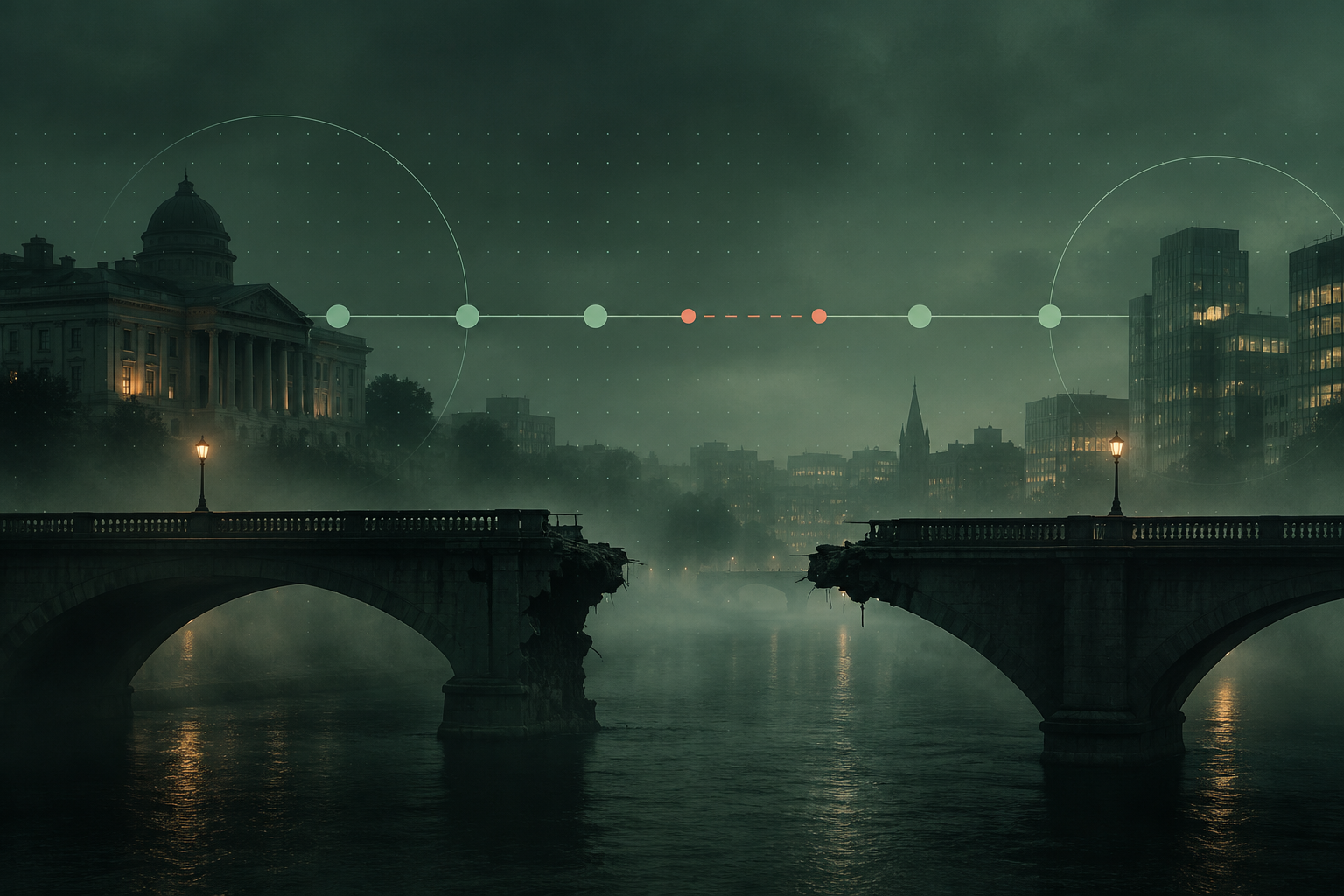
When the agent is someone else's problem
You ask a logistics platform to book a shipment, and its AI agent picks a route, confirms the price and sends a notification to the warehouse. Three weeks later the customer says the shipment never arrived and the agent never mentioned insurance. The platform says its logs show everything was fine. You have no idea what the agent actually did, because you never saw its working.
That is the situation more than half of executives are in, according to a survey by IBM reported by Kiteworks. 54 percent admit they have governance gaps for AI used by key vendors and supply-chain partners [1]. The agent acts on your organisation's behalf, but the records stay with the vendor. When something goes wrong, the question is what the agent did, and the vendor's word is all you have.
It is a bit like handing your car keys to a valet service that keeps no logbook. If the car comes back scratched, the service says it was fine when they parked it, and you have nothing to check that against.
What the AI Act says about logs
Article 12 of the AI Act says high-risk AI systems must technically allow for the automatic recording of events over their lifetime [2]. For systems under Annex III, that applies from 2 December 2027 [2]. Article 26 says the user of a high-risk system shall monitor its operation and keep the automatically generated logs the user has control over for at least six months [2][3].
Notice the words "has control over". If a vendor runs the AI, you may get a dashboard and an export file, but you do not control the underlying logs. You can ask for them, and the vendor can edit them before you see them, and you would not know. The regulation does not say the vendor must hand over tamper-proof logs. It says you, as the user, must monitor operation and keep the logs you have access to.
That is the governance gap. The obligation is yours, but the evidence is theirs.
When liability does not wait for governance
Liability does not pause while you sort out your vendor relationships. If the AI agent makes a decision that affects someone, you are the user under Article 26, and that carries duties [3]. You must use the system according to instructions, ensure human oversight and inform people affected by decisions [3]. On 9 December 2026, the EU's Product Liability Directive brings software under strict liability for defects [4]. If the agent is deemed defective and causes harm, the person injured does not need to prove you were careless, only that the product was defective and caused the damage [4].
The person asking questions will not care whether you ran the AI or a vendor did. They will ask you what happened, and if you cannot show it, the vendor's assurance that everything was logged correctly is not evidence. It is a claim.
What this means for you
If you use AI run by a vendor, ask these questions now:
- What does the AI do on our behalf, and where are the logs?
- Can we get a copy of the logs whenever we want, and can we check they have not been edited?
- If we are questioned about a decision or an action, what records will we have?
- Does the contract say who is liable when the AI gets it wrong?
If the answers are vague, that is the gap the survey found. Governance starts with knowing what records you will have on the day someone asks what your AI did.
How a witness helps when the vendor holds the logs
Say the vendor's AI agent logs every instruction it receives and every action it takes. Each log entry gets a fingerprint, and that fingerprint is sealed as the entry is written. The log itself stays with the vendor, but the seal is independent: anyone with the log entry can calculate its fingerprint and check it against the sealed one.
If the vendor sends you the logs six months later and says this is what the agent did, you check the fingerprints. If they match, the entries have not changed since the day they were sealed. If they do not match, someone has edited them. The vendor cannot quietly adjust a log entry without it showing, because the seal was made when the entry was written, not when you asked for the logs.
That is what a digital witness does in a vendor relationship: it gives you a way to check the vendor's records without having to trust that nobody touched them. WitniumChain lets vendors seal log entries as they happen, through a REST API, an SDK or an MCP server, and the first 2,000 seals a month are free [5]. The seal does not tell you whether the agent's decision was correct or whether the vendor followed the contract. It tells you whether the log is the one written on the day.
How it would work
- The vendor's agent writes each action to a log and seals the fingerprint immediately.
- Weeks or months later, you ask for the logs.
- You calculate the fingerprint of each entry and compare it with the sealed version. If it matches, nothing has changed.
What to watch
The high-risk requirements for systems in Annex III of the AI Act apply from 2 December 2027 [2]. That includes the logging duty in Article 12 and the user obligations in Article 26 [2][3]. If you use AI provided by a vendor, and that AI handles decisions about people, recruitment, creditworthiness, access to services or law enforcement, it is likely high-risk. The date is eighteen months away. The governance gap the survey found will not close by itself.
Sources
- [1]AI Agent Accountability and the Governance Gap, Kiteworks, 2024
- [2]Article 12, Regulation (EU) 2024/1689 (AI Act), European Commission AI Act Service Desk, 2024-08-01
- [3]Article 26, Regulation (EU) 2024/1689 (AI Act), EUR-Lex, 2024-07-12
- [4]Directive (EU) 2024/2853 on liability for defective products, EUR-Lex, 2024-10-23
- [5]WitniumChain documentation, Witnium, 2024