
Sector · Advertising and media
Cases · 2026-10-13 · 4 min read
Sweden bans misleading e-cigarette marketing in *landmark consumer case*
The Consumer Ombudsman has prohibited Leancom AB from using several marketing practices for e-cigarettes and refill containers on its website minprilla.se, and issued a similar order against Duderhof AB.

When the receipt matters more than the promise
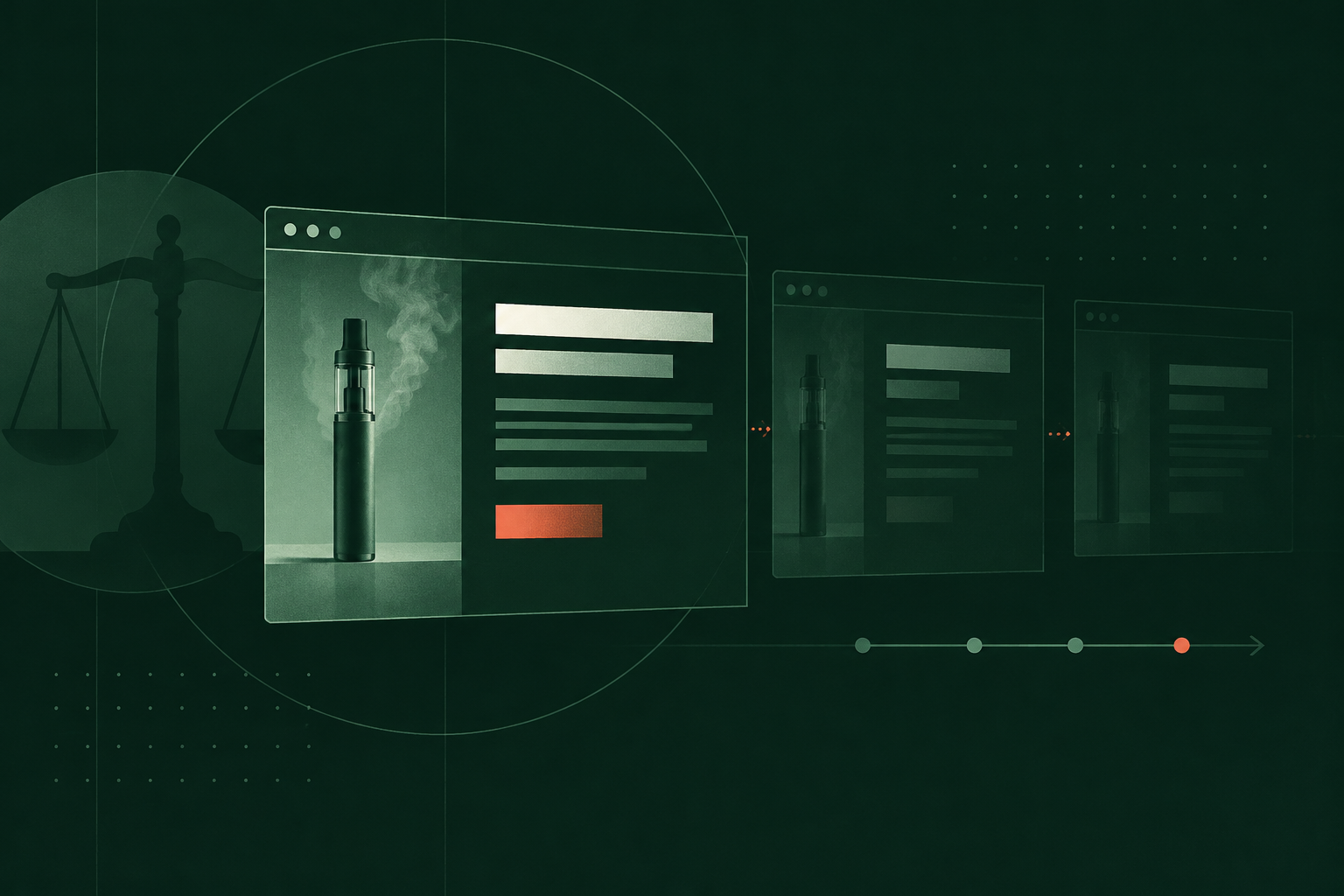
Imagine a shop window that changes every day. One week it says "nicotine-free option available", the next week that claim is gone, and by the time someone questions it the shopkeeper says it was never there. That is roughly what happens when marketing claims on a website can be edited at will, and it is why Sweden's Consumer Ombudsman has stepped in.
Konsumentombudsmannen (KO) has prohibited Leancom AB from using several marketing practices for e-cigarettes and refill containers on its website minprilla.se [1]. A similar prohibition has been issued against Duderhof AB for its site [1]. The orders concern claims that KO found misleading under the Marketing Act.
The details of what exactly was prohibited have not been published in the short notice on KO's website, but the case is a good example of a broader pattern: when marketing claims are made online, they can be questioned long after they first appeared, and the burden of proof tends to fall on the business.
What the Marketing Act says
The Swedish Marketing Act (marknadsföringslagen) prohibits marketing that is misleading [2]. That includes claims about a product's characteristics, availability or price that are likely to affect consumers' decisions. For products such as e-cigarettes, which are subject to specific health regulations, the rules are stricter still.
The Act also prohibits unfair commercial practices, which covers a range of behaviours from hidden advertising to pressure selling [2]. KO enforces the Act and can issue prohibitions, often combined with a penalty for non-compliance.
The evidence question
When a consumer or a competitor challenges a marketing claim months after it was made, the question is: what did the site actually say at the time?
Screenshots are one answer, but they are easy to dismiss. Anyone can edit a page in their browser, take a screenshot and claim that is what the site looked like. A business that has edited its own site in the meantime has no record of the earlier version, unless it kept one deliberately.
Archive services such as the Wayback Machine capture some pages, but not all, and not every day. If the claim in question was up for a week and then removed, it may never have been captured. That leaves both sides arguing about what might have been there, with no neutral record to settle it.
What KO's order means
For Leancom and Duderhof, the prohibitions are binding. If either company repeats the practices KO has prohibited, it faces a penalty. The size of the penalty, if one was set, has not been disclosed in the public notice.
For other businesses selling nicotine products online, the case is a reminder that marketing claims are KO's business, and that the claims you make today may be questioned a year from now. The question to ask is: if someone challenges a claim you made last spring, could you show what your site actually said?
A digital witness for marketing claims
Here, the thing to seal is each version of a product page as it goes live: the full text, images and any claims about characteristics, availability or price. Sealing takes a fingerprint of the page, not the page itself, so the content stays on your servers.
If a claim is challenged months later, you can show the sealed version to KO, a court or the other party. Anyone you share it with can check that it is exactly what was published on that date, unchanged since it was sealed. It does not show that the claim was lawful or accurate, but it does show what you actually published.
WitniumChain [3] lets you seal pages through the REST API, the SDK or the MCP server. The first 2,000 witnesses a month are free.
How it would work
- When a page goes live, your system sends a fingerprint of it to WitniumChain and gets a witness ID back.
- The sealed fingerprint is stored on a chain where any later change would show, even one made by us.
- If the page is questioned, you calculate the fingerprint again and compare it with the sealed one. If they match, nothing has changed.
What this means for you
If you sell products online, especially regulated ones, ask yourself:
- Could you show what your site said about a product six months ago?
- Do you keep records of every version of your product pages, terms and prices?
- If a screenshot of your site turned up in a dispute, could you confirm or dispute it with your own record?
KO's case against Leancom and Duderhof will not be the last of its kind. The marketing you publish today may be the evidence in a case next year.
Sources
- Konsumentverket, Föreläggande mot Leancom AB, 2024, https://www.konsumentverket.se/forelaggande/forelaggande-mot-leancom-ab/
- Marknadsföringslag (2008:486), Riksdagen, https://www.riksdagen.se/sv/dokument-och-lagar/dokument/svensk-forfattningssamling/marknadsforingslag-2008486_sfs-2008-486/
- WitniumChain documentation, Witnium, https://witniumchain.com/docs
Sources
- [1]Föreläggande mot Leancom AB, Konsumentverket, 2024
- [2]Marknadsföringslag (2008:486), Riksdagen, 2008
- [3]WitniumChain documentation, Witnium, 2024