
Sector · HR and recruitment
Cases · 2026-10-14 · 4 min read
Third-party AI in hiring does not eliminate employment-law risk
Workday faces discrimination litigation over its AI recruitment tools, illustrating that using an external vendor's automated screening system does not shield employers from liability when hiring decisions go wrong.

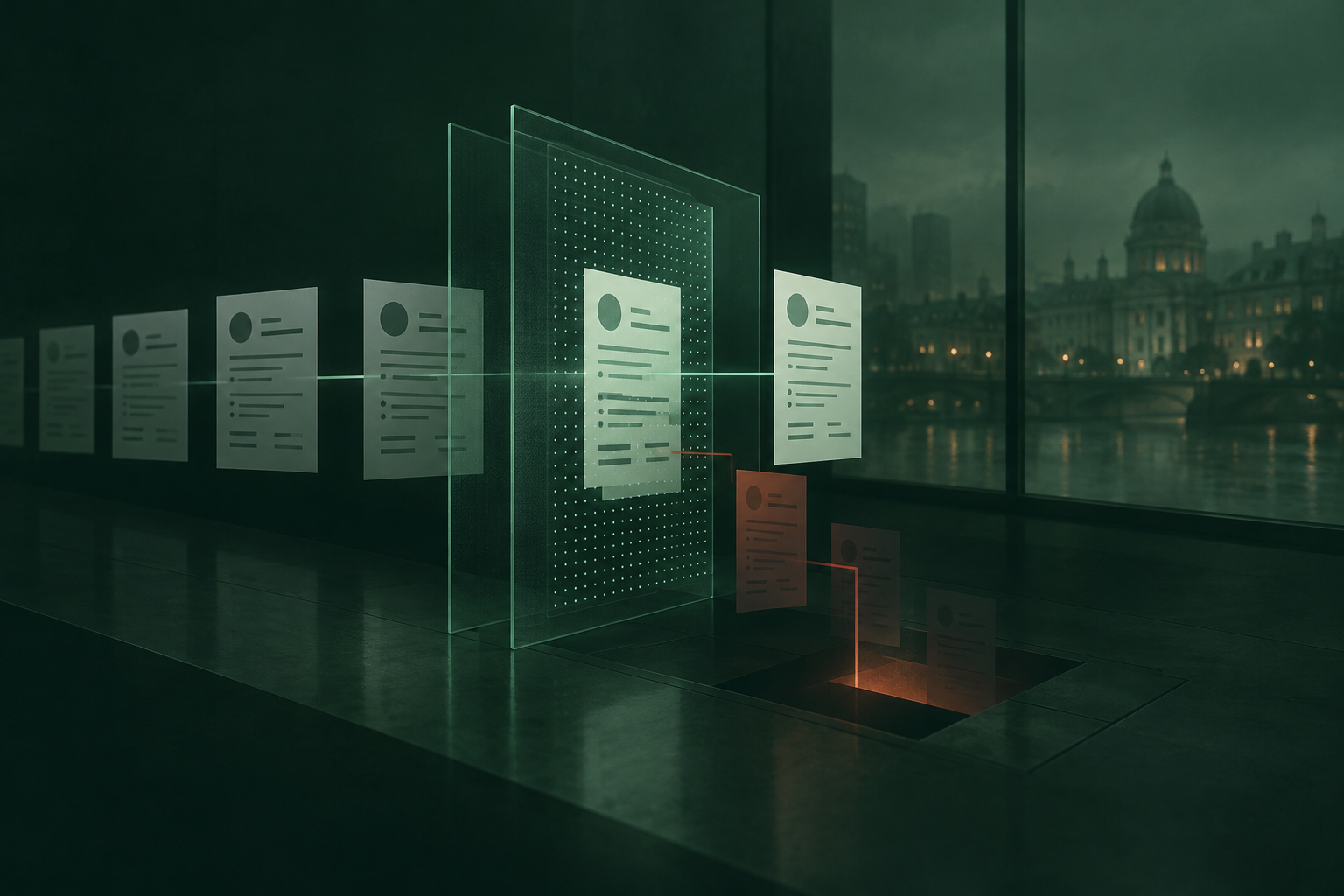
When the vendor's AI screens your candidates
Workday, a provider of cloud-based HR systems, is facing a proposed class action in California over its AI-driven screening tools. The plaintiffs claim the tools discriminate against older applicants, Black candidates and people with disabilities, in breach of federal and state civil rights laws. They say Workday's screening scores candidates in ways that produce biased outcomes, and that the company has been aware of the risk but continued to market the tools as objective [1].
Workday has called the claims baseless and says it will defend itself [1]. But the case highlights a point every employer using third-party recruitment AI should think about: the vendor built the tool, but you are the one making the hiring decision.
It's like hiring a security guard to check IDs at the door. If the guard turns away the wrong people, you still own the problem, because it's your door.
The employer is still the one deciding
Under US law, an employer is liable for discrimination in hiring, regardless of whether the screening is done in-house or by a vendor. The Supreme Court clarified in Griggs v. Duke Power Co. that employment practices with a disparate impact on protected groups are unlawful unless the employer can show they are job-related and consistent with business necessity [2]. It does not matter who designed the test.
The same principle runs through the EU's AI Act. Article 26 sets out the obligations of deployers (the people using high-risk AI systems), and it treats the deployer as responsible for using the system properly, monitoring its performance and ensuring human oversight [3]. Buying AI from a reputable vendor is not a defence if the system produces discriminatory outcomes.
The evidence question when it goes to court
When a hiring decision is challenged, the question shifts from what the AI was supposed to do to what it actually did. That means looking at the inputs, the model version, the score and any human review. If the employer cannot show what happened on the day the candidate was screened, the case becomes harder to defend.
High-risk AI for recruitment and employment falls under Annex III of the AI Act, which means it must allow for automatic logging of events over its lifetime from 2 December 2027 [3]. The log must be enough to let the deployer monitor the system and to allow authorities to assess compliance. Article 12 does not say how to protect the logs, but it is clear they must exist.
In litigation, the side without its own records starts on the back foot. If the vendor keeps the logs, the employer has to ask for them. If the logs can be edited, either side can question them. A log you can quietly change is a diary; a log you can prove hasn't changed is evidence.
What a digital witness does here
Say a bank uses an automated screening tool to assess job applicants. Each candidate is scored, and the system recommends rejection or progression to the next round. The decision is logged: candidate reference, model version, inputs, score, recommendation and the name of the recruiter who reviewed it.
The thing to seal is that decision record, as it is written. Sealing takes a fingerprint of the record, not the data itself, so the candidate's details never leave the bank's systems. The fingerprint goes to WitniumChain through the REST API, the SDK or the MCP server, and the bank gets a witness ID back. If the decision is challenged six months later, the bank calculates the fingerprint again and checks it against the sealed one. If it matches, nothing has changed. Change a single character and it won't match.
Anyone the bank shares the record with—the candidate, an employment tribunal, a regulator—can do the same check. The witness shows that the record is exactly what was written on the day. It doesn't show that the decision was fair, lawful or free of bias, or that the log is complete. But it does mean the bank has its own checkable record, one that neither the bank nor the vendor can quietly rewrite.
The first 2,000 witnesses a month are free. Read the docs for integration details.
What this means for you
If you use third-party AI to screen candidates, ask yourself:
- Do you have your own record of what the AI did for each decision, or does the vendor keep the only log?
- If a candidate questions a decision in a year's time, can you show which model version ran, what it scored and who reviewed it?
- Can anyone with the right access edit the log after the fact, and would you be able to show they hadn't?
- Does your contract with the vendor say who owns the logs and how long they are kept?
Article 26.7 of the AI Act says deployers must inform workers' representatives and affected workers before high-risk AI is used in the workplace [3]. That includes telling them how the system works and what role it plays in decisions. If your screening tool will be high-risk from December 2027, the conversation with your works council or unions should start now.
What to watch
The Workday litigation is at an early stage, and the company denies the allegations. But the case has already drawn attention from US lawmakers. Senator Ron Wyden has written to Workday asking what steps it is taking to prevent discrimination, and whether it will commit to independent audits [1].
In the EU, the AI Office has not yet published detailed guidance on what counts as adequate logging for recruitment systems. When it does, employers and vendors will know more about what regulators expect to see. Until then, the safe approach is to assume that a log you cannot prove is unchanged will be questioned the day it matters.
2 December 2027 is the date high-risk requirements for Annex III systems come into force [3]. That gives employers about 18 months to work out how their systems will log events, who will keep the logs and how they will be protected. Starting that conversation now is cheaper than starting it in discovery.
Sources
- [1]Workday Hit With Class Action Over AI Hiring Tools, Bloomberg Law, 2024-03-14
- [2]Griggs v. Duke Power Co., 401 U.S. 424 (1971), Supreme Court of the United States, 1971-03-08
- [3]Regulation (EU) 2024/1689 on Artificial Intelligence (AI Act), European Commission, 2024-07-12