
Sector · Legal
Cases · 2026-10-12 · 4 min read
Thomson Reuters wins AI copyright appeal: what the case says about *training data records*
The 3rd Circuit upheld Thomson Reuters' copyright win against Ross Intelligence, a former legal-research rival accused of using copyrighted materials to train its AI. The ruling turns on what Ross couldn't prove about its data.

The ruling and the records gap
Thomson Reuters, the legal publisher behind Westlaw, sued Ross Intelligence in 2020, claiming Ross had scraped Westlaw's copyrighted headnotes and case summaries to train its AI-powered legal-research tool [1]. Ross had positioned itself as a competitor to Westlaw, marketing an AI system that could answer legal questions in natural language.
In January 2023, a district court in Delaware found that Ross had infringed Thomson Reuters' copyrights and granted summary judgement in favour of Thomson Reuters [2]. Ross appealed. On 8 May 2025, the 3rd Circuit Court of Appeals upheld that ruling [1].
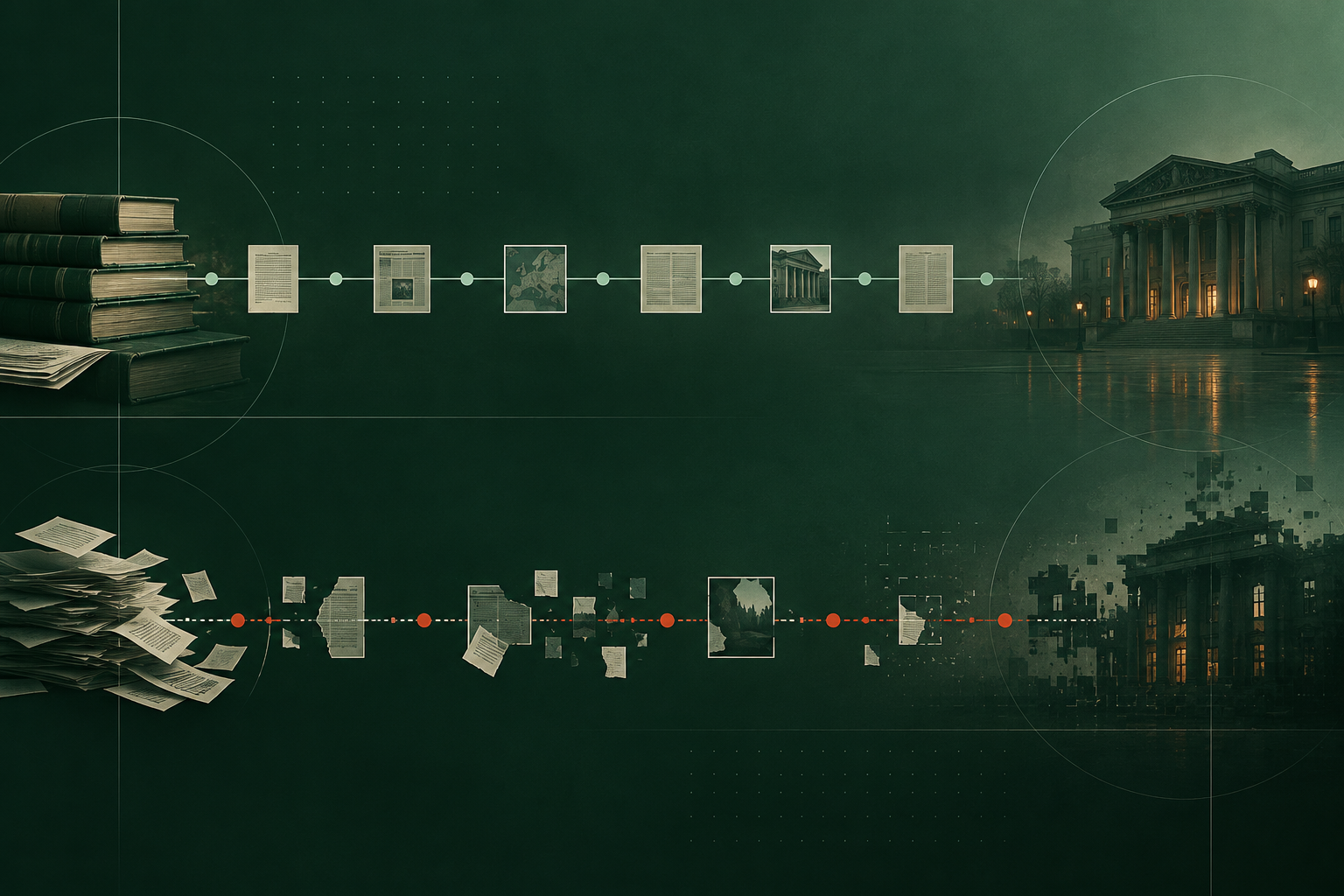
The interesting part for anyone building or buying AI is what the courts said about Ross's records. Ross could not produce clear documentation of what data its system had been trained on. The district court noted that Ross's own witnesses gave inconsistent testimony about the training process, and that Ross had not kept systematic records of which materials went into which versions of its model [2]. When you are accused of copying and you cannot show what you used, the other side's evidence carries more weight.
It is a bit like being asked for a receipt after you have thrown it away. The lack of a receipt does not prove you stole the item, but it does not help your case.
What the law will ask for
Under the AI Act, high-risk AI systems must have data governance procedures in place [3]. Article 10 says providers must ensure training, validation and test data sets are "relevant, sufficiently representative, and to the best extent possible, free of errors and complete" [3]. The regulation does not say you must seal your data sets, but it does say you must document them, and that documentation may be requested by notified bodies, customers and supervisors.
For high-risk systems falling under Annex III, Article 10 applies from 2 December 2027 [4]. For general-purpose AI models with systemic risk, documentation duties under Article 55 already apply [5].
Outside the AI Act, copyright disputes over training data are not going away. When a rights holder claims infringement, you will want to show what your model learned from. If the question comes up two years and three model versions later, a data lineage you have kept since the beginning is easier to defend than one you try to reconstruct from memory.
What this means for you
If you are training AI models, ask:
- Do we keep a manifest or snapshot of each training, validation and test data set when we freeze it for use?
- Can we show, two years from now, which version of a data set went into which model release?
- If a regulator, a customer or a court asks what our model learned from, do we have records that hold up?
- Who decides what counts as adequate documentation, and have we asked them?
If you are procuring AI, consider:
- Does the supplier document its training data, and would it share that documentation in an audit or a dispute?
- If the system turns out to infringe someone's rights, do we have a clear trail back to what it learned from?
How a digital witness fits here
The thing to seal is a manifest or snapshot of each training, validation and test data set when it is frozen for use. That means the list of files, their fingerprints, their sources and the date the set was locked. The data itself stays with you.
Sealing takes a fingerprint of the manifest, not the data. Your system sends that fingerprint to WitniumChain through the REST API, the SDK or the MCP server, and gets a witness ID back. Read the docs for how to integrate it. The first 2,000 witnesses a month are free.
To check, anyone you share the manifest with can calculate the fingerprint again and compare it with the sealed one. If they match, the manifest is exactly what existed when the data set was frozen. Change a single line and it will not match.
A digital witness shows which version of a data set existed at what time, unchanged since. It does not show that the data was representative, lawful or free of bias. It does not show that the sealed manifest is the data the model actually learned from, if someone substituted a different set at training time. It gives you a dated record of the data sets you prepared, in a form that nobody, including you, can quietly rewrite later.
How it would work
- When you freeze a data set for training, generate a manifest: file names, fingerprints, sources, date.
- Seal the manifest and store the witness ID with the model version.
- If the data lineage is questioned later, share the manifest and let the other side check it.
What to watch
Article 10 of the AI Act, on data governance for high-risk systems, applies from 2 December 2027 for Annex III systems [4]. Documentation duties for general-purpose AI models with systemic risk under Article 55 already apply [5].
Copyright litigation over AI training data is ongoing in multiple jurisdictions, including cases against OpenAI, Stability AI and others. The outcomes will clarify what counts as fair use or as transformative use in training, but the principle that you need to show what you used is unlikely to go away.
Sources
- [1]Thomson Reuters wins AI copyright appeal against Ross Intelligence, Reuters says, Legal Technology, 2025-05-08
- [2]Thomson Reuters Enterprise Centre GmbH v. Ross Intelligence Inc., Civil Action No. 20-613-LPS, United States District Court for the District of Delaware, 2023-01-17
- [3]Article 10: Data and data governance, European Commission AI Act Service Desk, 2024-08-01
- [4]Timeline for the implementation of the EU AI Act, European Commission AI Act Service Desk, 2024-12-09
- [5]Article 55: Obligations for providers of general-purpose AI models, European Commission AI Act Service Desk, 2024-08-01