
Sector · Retail and e-commerce
Rules · 2026-11-03 · 4 min read
UK consumer law now applies to AI agents, and logs are how you prove what they did
The UK Competition and Markets Authority has published guidance requiring companies to train AI agents to comply with consumer law and to monitor their performance. When an agent books a hotel nobody wanted, the log is the evidence.

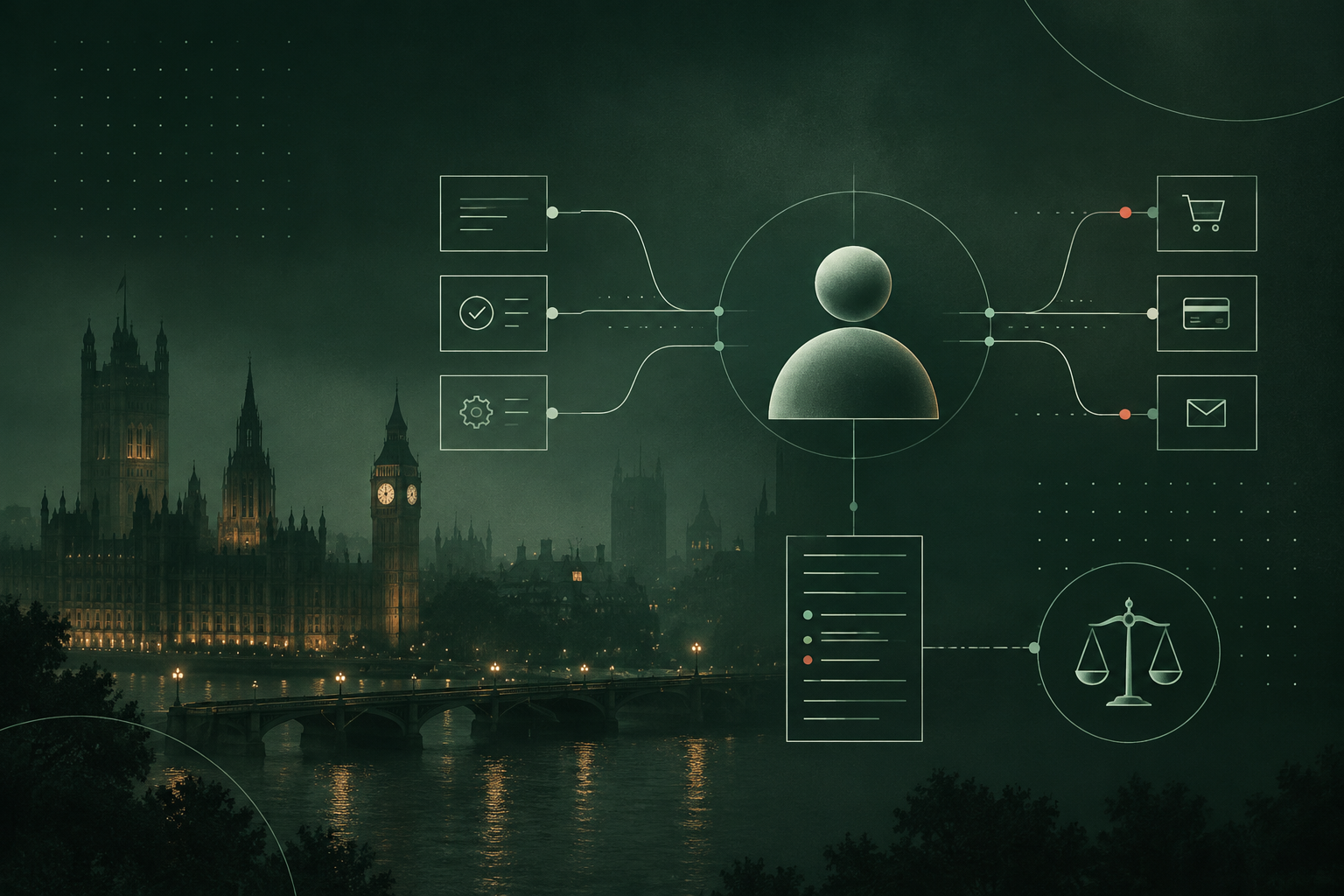
The guidance that treats AI agents as employees
On 23 April 2025, the UK Competition and Markets Authority published guidance titled Complying with consumer law when using AI agents [1]. It says what companies must do when they let an AI agent act for them: book tickets, change orders, recommend products or handle complaints.
The guidance is short and direct. Agents must respect statutory consumer rights. They must follow the business's contract terms. They must respect cancellation rights. And the business is responsible for what its agents do, in the same way it is responsible for what its staff do [1].
That last point is the one that changes things. An agent that books the wrong hotel room or cancels a subscription the customer wanted to keep isn't a technical glitch. It's a business decision, and the business has to stand behind it.
What the guidance requires
The CMA sets out three core duties [1].
First, train the agent. The business must ensure the agent understands consumer law and the business's own obligations. That means testing it before deployment and checking that it knows what it can and cannot promise.
Second, monitor performance. Once the agent is running, the business must watch what it does. The guidance talks about logging, auditing and reviewing outcomes, especially in areas like pricing, contract terms and complaints handling [1].
Third, act when things go wrong. If an agent breaches consumer law, the business must put it right. That might mean a refund, a cancellation or an apology, depending on what happened [1].
The guidance applies from the day a business deploys an agent. There is no grace period [1].
Where logs come in
The practical question is: how do you prove what your agent did?
Say a customer complains that an agent changed their delivery address without asking, or booked a non-refundable ticket when the customer asked for a flexible one. The customer has a screenshot or a memory. You have a log.
If the log is kept in a system that the same people who run the agent can edit, the customer or a regulator can question whether the record is complete. That is the problem Article 12 of the AI Act addresses for high-risk systems, by requiring logs that can be checked [2]. The CMA's guidance doesn't mention the AI Act, but the principle is the same: you need to be able to show what happened.
A log is like a till receipt. Nobody looks at it until there is a disagreement, and then it is the only thing that matters.
What this means for you
If you are deploying an AI agent that can act on a customer's behalf, or change an order, or make a recommendation that affects a purchase, ask these questions now:
- Can the agent explain its reasoning in plain language, so a customer or a regulator can follow it?
- Are you logging each instruction the agent receives, each tool it calls and each result it gets back?
- Can you show, six months later, what the agent did on a given day and why?
- Who checks the logs, how often, and what happens when something looks wrong?
- If a customer disputes what the agent did, whose record wins: theirs or yours?
The CMA guidance is principles-based, which means there is no checklist [1]. But the questions above are a decent start.
How a digital witness fits
Here, the thing to seal is each action the agent takes: the instruction it received, the tool call it made, the result and the time. Sealing takes a fingerprint of the record, not the data, so the instruction itself never leaves your systems.
You seal as the agent acts, through the REST API, the SDK or the MCP server. When a customer disputes what happened, anyone you share the record with can check that it is exactly what was logged at the time, unchanged since.
What it shows is that the record is the one written on the day. What it doesn't show is that the agent acted correctly, or that the instruction was lawful, or that you responded to the complaint properly. Those are separate questions, and a digital witness doesn't answer them.
WitniumChain has been running in production since 2018 [3]. The first 2,000 witnesses a month are free.
How it would work
- Your agent management system sends a fingerprint of each action record to WitniumChain and gets a witness ID back.
- The record and the witness ID are stored together in your own systems.
- When a dispute arises, you or the customer can check the record against the sealed fingerprint.
What to watch
The CMA guidance applies immediately [1]. In the EU, Article 26 of the AI Act will require users of high-risk AI systems to monitor their operation from 2 December 2027 [2]. The systems in Annex III of the AI Act include those used to evaluate creditworthiness, assess insurance risk and make recruitment decisions [4].
If your agent does any of those things, the monitoring duty will apply. Logs are how you show you did it.
The UK is not in the EU, but many businesses operate in both. The principles are converging: when an AI system acts, you need to know what it did and be able to show it.
In the meantime, the CMA guidance is the clearest statement yet that an agent is not a separate entity with its own responsibilities. It is your agent, and what it does is what you do.
Sources
- [1]Complying with consumer law when using AI agents, UK Competition and Markets Authority, 2025-04-23
- [2]Article 12, Regulation (EU) 2024/1689 (AI Act), European Commission AI Act Service Desk
- [3]WitniumChain documentation, Witnium
- [4]Annex III, Regulation (EU) 2024/1689 (AI Act), European Commission AI Act Service Desk