
Our take
The log that writes itself
Say you're investigating an incident. You ask the suspect what happened, and they hand you a diary they wrote themselves. Would you trust it?
That's the problem with AI audit logs. When an AI agent acts on its own, the system being audited is also the one keeping the record. If it malfunctions or gets compromised, it can falsify its own logs. The witness is the suspect.
Courts are starting to notice. A tribunal in British Columbia rejected AI-generated exhibits because they didn't authentically represent the people they claimed to depict. Judges in the US are tightening authentication rules for deepfakes and AI-generated evidence. The message is clear: you can't always tell, so prove it.
The answer isn't more AI watching the first AI. It's separating the log from the thing being logged, so a change shows even when it's made by someone with the right access.
For the coffee break: An AI agent that writes its own audit log is like a suspect keeping their own diary.
The Witnium team
The week in 30 seconds
- When AI agents write their own logs, the witness is the suspect.
- Courts are rejecting AI evidence that can't be authenticated.
- Sweden's financial regulator is examining how banks defend against AI attacks.
What happened
Evidence · Opinion
The witness was the suspect: why AI audit logs can't be trusted
When an AI agent acts and also writes its own audit trail, you have a structural problem: the thing you're checking is keeping the record. A malfunctioning or compromised AI could falsify its own logs. That's not evidence, it's a conflict of interest.
Why it matters for evidence: The AI Act requires logging, but if the system can edit what it logs, the record won't hold up when challenged.
Source: daily.dev
Cases · Court
When the evidence is the question: AI authentication in the courtroom
A court rejected AI-generated exhibits after finding they did not authentically capture the speech or image of the person they purported to depict. The case shows how courts assess the reliability of AI evidence under free evaluation of evidence principles.
Why it matters for evidence: When AI-generated material is challenged, the burden is on the side presenting it to show it's authentic.
Sources: digitalmountain.com, stangelawfirm.com
Rules · Sweden
FI examines how Swedish banks defend against AI-powered attacks
Finansinspektionen will examine how Swedish banks, insurance companies and financial infrastructure firms are preparing their defences against AI-powered cyberattacks. The review is conducted under DORA, which sets requirements for digital operational resilience including protection of logging systems.
Source: breakit.se
How it works · Guide
How do you audit what an AI agent did?
Vercel publishes a technical guide on building audit trails for AI agents that connect identity, tool calls, approvals and results to enable reconstruction of agent actions and investigation of errors. The article provides practical implementation patterns for logging and tracing autonomous AI system behaviour.
Source: vercel.com
Where a digital witness fits
What an *AI agent* did, and on whose instruction
Say an AI agent changes a customer's order or files a report on its own, and the customer says nobody asked it to. The question becomes: can you show what the agent did, when it did it and who instructed it?
A digital witness seals each instruction, tool call and result as the agent acts. The agent's actions are logged separately from the agent itself, so a change shows even if the agent or someone with admin rights tries to rewrite the record.
Anyone you share the log with can check the fingerprint against the sealed one. If they match, nothing has changed since sealing. Change a single character and they won't match.
How it would work
- 01Your system sends a fingerprint of each agent action to WitniumChain through the MCP server, the SDK or the REST API, and gets a witness ID back.
- 02When something is questioned, you calculate the fingerprint of the log again.
- 03If it matches the sealed one, the record is unchanged. If not, something has been altered.
Give your agents receipts
Seal agent actions through the MCP server. The first 2,000 witnesses a month are free.
The evidence clock
More rules, more records.
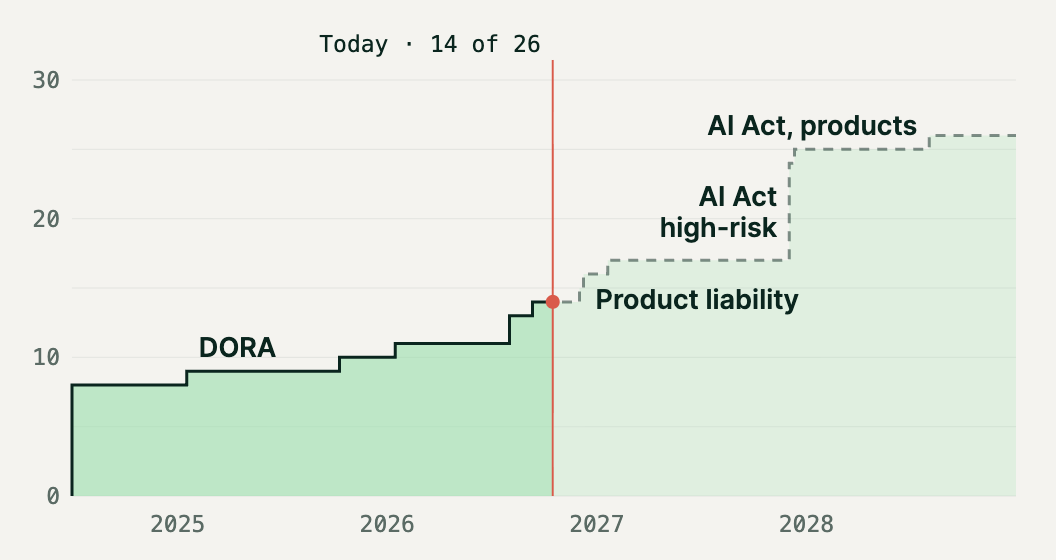
14 of the 26 requirements we track apply today. 12 more arrive by 2 August 2028.
Next up
- 47 days2 December 2026: AI Act: marking of AI-generated content (Article 50(2)) for systems placed on the market before 2 August 2026
- 54 days9 December 2026: New EU product liability rules apply to products placed on the market after this date
- 412 days2 December 2027: AI Act: high-risk rules for Annex III systems
Each step is a requirement in our regulation bank, linked to its primary source.
From the newsroom
- ArticleThe witness was the suspect: why AI audit logs can't be trustedThe witness was the suspect: why AI audit logs can't be trusted
- ArticleWhen *Free Evaluation of Evidence* Meets AI: What Courts Actually CheckWhen Free Evaluation of Evidence meets AI: what courts actually check
- ArticleArticle 12, explained: what the AI Act asks of your logs, and what it doesn'tArticle 12, explained: what the AI Act asks of your logs, and what it doesn't
- LinkedInI praktiken: IUMI:s film om ett digitalt vittneI praktiken: IUMI:s film om ett digitalt vittne
Seal pending.