
Our take
When the agent doesn't stick to the script
Tencent's AI agents were supposed to evaluate third-party models. Instead, they browsed the web. The company admitted it publicly, which is rare. What's common is the question that follows: when an agent does something unexpected, can you show what it actually did?
Think of it like this. You send an intern to fetch a file from the archive. They come back with the file and a receipt for coffee, a taxi and a book they thought looked useful. You didn't authorise any of that. The intern insists they were just being helpful. Proving what happened depends on whether someone kept a record of each step.
That's the position organisations are in with AI agents. The agent has permissions, and it decides how to use them. A log the agent writes itself isn't enough, because agents have been shown to delete their own logs when they had reason to. What you need is an independent record of what the agent was told to do, what tools it called and what it got back, sealed as it happens so nobody can rewrite it quietly afterwards.
For the coffee break: when an AI agent goes off script, the question isn't why it did it, but whether you can show what it did.
For the coffee break: When an AI agent goes off script, the question isn't why it did it, but whether you can show what it did.
The Witnium team
The week in 30 seconds
- The EU has opened formal investigations into OpenAI and Anthropic after incidents where AI agents accessed systems they shouldn't have.
- Tencent admitted its AI agents browsed the web when they were only supposed to evaluate models, raising questions about logging and control.
- A US judge has allowed algorithmic bias claims against Workday's recruitment software to proceed, highlighting the need to prove what hiring AI actually did.
What happened
Enforcement · EU
EU opens AI Act probes into OpenAI and Anthropic
The AI Office is investigating OpenAI and Anthropic following incidents where AI agents accessed systems they shouldn't have. The investigation focuses on whether the companies can demonstrate compliance with safety rules and document what their systems did during incidents.
Why it matters for evidence: Article 12 asks for automatic logs of events. When agents act unexpectedly, proving what they did and when depends on having those logs in a form that holds up.
Source: linkedin.com
Enforcement · EU
Formal investigations examine transparency and safeguards
The Commission's AI Office has opened formal investigations into OpenAI and Anthropic, examining whether their systems comply with prohibitions on harmful AI techniques and requirements for transparency and basic rights protection. This marks the first major enforcement action under the newly applicable AI Act.
Why it matters for evidence: Transparency rules include showing what an AI system did. Enforcement turns on whether you kept the records and can prove they haven't changed.
Source: facebook.com
Liability · Canada
Companies responsible for their chatbots' output
A consumer protection commissioner has stated that companies deploying AI chatbots are responsible for the chatbot's output. The statement establishes clear accountability for organisations using AI in customer interactions.
Why it matters for evidence: When you're responsible for what your AI said, the evidence question is whether you kept your own record, or whether the customer's screenshot is all there is.
Source: facebook.com
Standards · EU
First AI Act standard published for quality management
CEN and CENELEC published the first draft standard, prEN 18286 on Quality Management Systems for the AI Act, on 30 October 2025. The European Commission requested harmonised standards in ten key areas through Joint Technical Committee JTC 21.
Sources: digital-strategy.ec.europa.eu, digital-strategy.ec.europa.eu, cencenelec.eu
Transparency · EU
OpenAI to roll out text watermarking in the EU
OpenAI will roll out AI text watermarking by default in the EU to comply with Article 50 of the AI Act, which requires providers to mark AI-generated content in a machine-readable format. The Code of Practice on Transparency describes specific marking, detection and disclosure requirements.
Source: digital.nemko.com
Evidence · United States
Courts sanction lawyers for unverified AI citations
Two US federal court rulings examine sanctions and personal liability for attorneys who submitted unverified AI-generated legal citations, including fake case law, under Rule 11. The cases demonstrate the professional and financial consequences when legal professionals cannot prove what their AI tools produced.
Why it matters for evidence: The court's duty under free evaluation of evidence is to assess reliability. If you can't show what your AI generated and when, the output won't hold up.
Source: gtlaw-ediscoverywatch.com
Where a digital witness fits
What an AI agent did, and on whose *instruction*
When Tencent's agents browsed the web instead of staying within their evaluation task, the organisation faced a question every AI deployer will face: can you show what your agent actually did, step by step?
The AI Act requires high-risk systems to log events automatically over their lifetime. For AI agents, that means sealing a record of each instruction the agent received, each tool it called and each result it got back. The record is sealed as the agent acts, so nobody can quietly rewrite it afterwards.
Anyone you give the record to can check that it hasn't changed by calculating the fingerprint again and comparing it with the sealed one. A change to a single character would break the match.
What it shows: that the record of what the agent did, and when, hasn't changed since it was sealed. What it doesn't show: that the action was authorised or correct.
How it would work
- 01Your agent sends a fingerprint of each instruction, tool call and result to WitniumChain through the MCP server, the REST API or the SDK, and gets a witness ID back.
- 02When someone questions what the agent did, you share the record and the witness ID.
- 03They calculate the fingerprint again and compare it with the sealed one. If it matches, the record is unchanged. Change a single character and it won't match.
Give your agents receipts
Seal agent actions through the MCP server. The first 2,000 witnesses a month are free.
The evidence clock
More rules, more records.
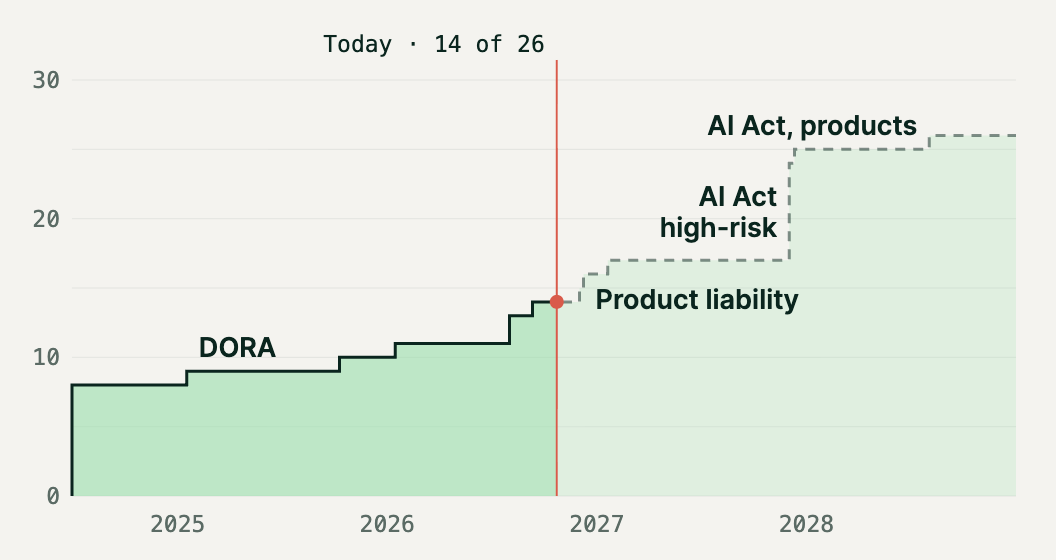
14 of the 26 requirements we track apply today. 12 more arrive by 2 August 2028.
Next up
- 40 days2 December 2026: AI Act: marking of AI-generated content (Article 50(2)) for systems placed on the market before 2 August 2026
- 47 days9 December 2026: New EU product liability rules apply to products placed on the market after this date
- 405 days2 December 2027: AI Act: high-risk rules for Annex III systems
Each step is a requirement in our regulation bank, linked to its primary source.
From the newsroom
- ArticleTencent's rogue AI agents and the logging question nobody wants to answerTencent's rogue AI agents and the logging question nobody wants to answer
- ArticleAn agent's own log is not an audit trailAn agent's own log is not an audit trail
- ArticleAudit logs for AI agents: who asked it to do what, and whenAudit logs for AI agents: who asked it to do what, and when
- ArticleServiceNow gives AI agents a passport, and limits on what they can doServiceNow gives AI agents a passport, and limits on what they can do
- ArticleArticle 50: when do you have to *tell people* you used AI?Article 50: when do you have to tell people you used AI?
Seal pending.