
How it works · 2026-10-09 · 4 min read
What a digital witness proves, and what it doesn't
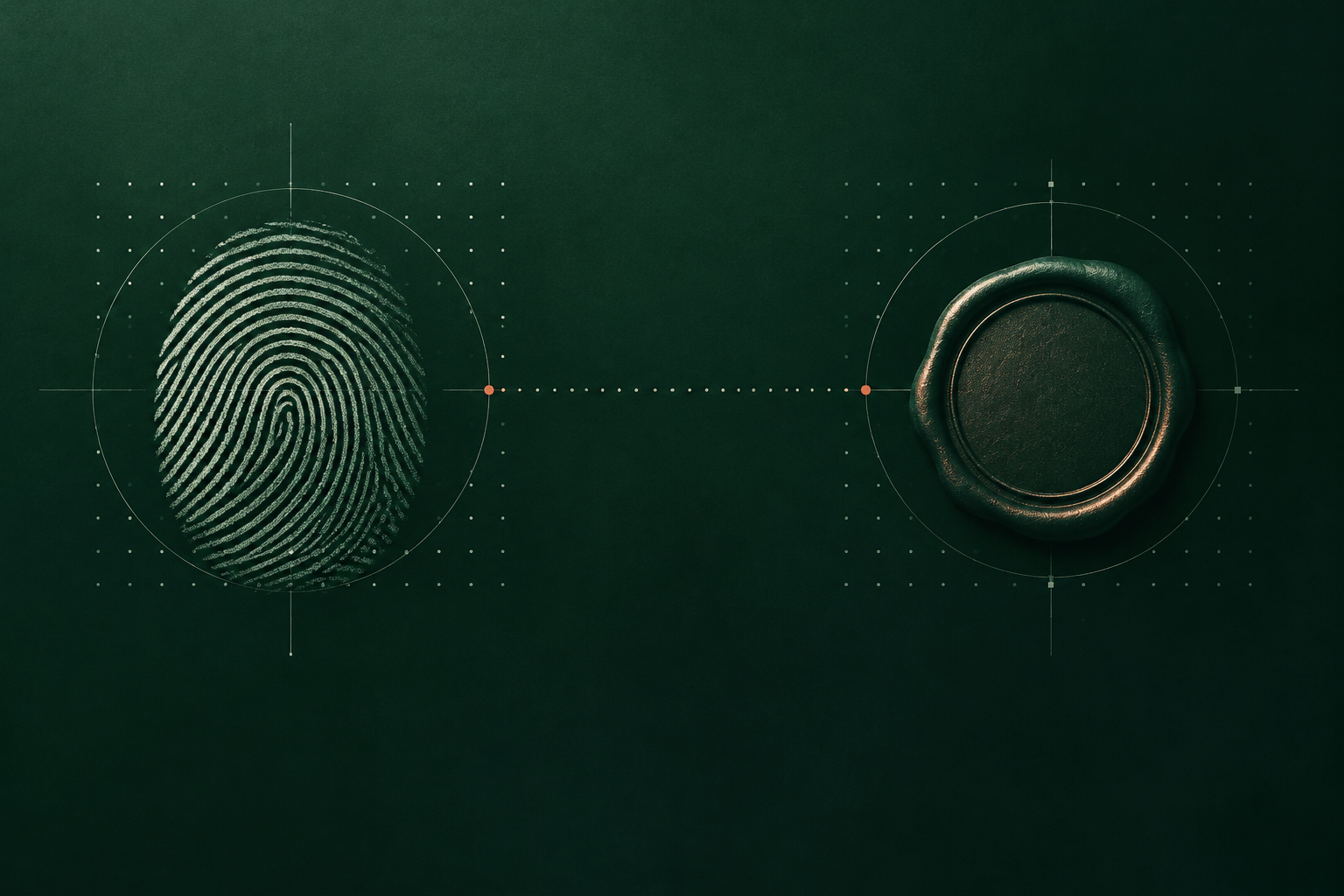
A fingerprint and a seal show that something existed at a point in time and has not changed since. They do not prove the content is true, or who created it, or that nothing is missing.

The fingerprint
A digital witness starts with a cryptographic hash, a mathematical function that takes any input and produces a fixed-length string of characters. The same input always gives the same hash. Change a single character and the hash changes completely. The hash itself reveals nothing about the original data.
That fingerprint is sent to a sealing service, where it is recorded with a timestamp and stored in a way that makes later alteration visible. The original data stays with whoever created it. Only the fingerprint travels.
Sealing and time
The seal fixes two things: a moment and a state. It records that a particular fingerprint existed at a particular time.
Under eIDAS, an electronic timestamp may not be denied legal effect or admissibility as evidence solely because it is in electronic form or because it does not meet the requirements for a qualified electronic timestamp [1]. A qualified timestamp enjoys a presumption that the date, time and integrity it indicates are accurate [1]. WitniumChain is not currently a qualified timestamp, so it does not carry that presumption, but it does provide an independently verifiable record.
The timestamp matters in disputes. If two parties disagree about when a document was finalised, or which version was in force on a given date, a sealed fingerprint settles the question.
What a match means, and what a mismatch means
Anyone with the original data can recalculate the fingerprint and compare it to the sealed version. If they match, the data has not changed since sealing. If they do not match, something has changed, even by a single character.
That check is what makes a digital witness useful. It removes the need to trust whoever holds the data. The fingerprint either matches or it does not.
A match proves two things: the data existed at the time of sealing, and it has not been altered since. It does not prove the content was accurate when it was sealed. A photograph can be sealed and later shown to be unaltered, but sealing does not prove the photograph was not staged, or that it depicts what someone claims it depicts.
The limits
A digital witness does not prove truth. It proves state. If a log says an event happened at 14:03, and the log is sealed and later shown to match, the seal proves the log has not changed. It does not prove the event actually happened at 14:03, or that the log is complete.
It does not prove authorship unless the creator signs the data before sealing. A sealed fingerprint shows that a file existed and has not changed. Without a digital signature linking the file to a person or organisation, the seal does not identify who created it.
It does not prove completeness. A sealed set of documents proves those documents have not changed. It does not prove nothing was left out. If a party seals ten emails, the seal does not prove there was no eleventh.
It does not offer absolute security. The sealing infrastructure can be attacked, the cryptographic methods can be broken by future technology, and the organisation running the service could in theory alter records if it chose to subvert its own design. The design makes such changes visible, and the distributed nature of a blockchain makes them impractical, but no system is invulnerable. Claims of tamper-proof or immutable records overstate what any technology can deliver.
Privacy and fingerprints
A cryptographic hash of non-personal data is not personal data. A hash of the sentence "The meeting started at 09:00" reveals nothing about a person.
A hash of personal data can itself be personal data. The GDPR requires that personal data be adequate, relevant and limited to what is necessary, and that it be processed in a manner that ensures appropriate security, including protection against unauthorised or unlawful processing and against accidental loss, destruction or damage [2].
If the input is a document that relates to an identifiable person, and the hash is stored in a way that allows someone to link it back to that person, the hash may fall within the scope of the GDPR. The European Data Protection Board has said that pseudonymised data, including hashed data, remains personal data when the controller or another party can reverse the pseudonymisation [3].
That means two things. First, decide early whether the data you are sealing contains personal information. Second, if it does, apply the same data minimisation and security rules you would apply to the data itself. Seal only what is necessary, and ensure you have a lawful basis for processing.
In practice, many uses of digital witnesses involve no personal data at all: version records of software, timestamped decisions in automated systems, or documents relating to organisations rather than individuals. Where personal data is involved, the fingerprint can still be used, but the same rules apply.
What this means for you
Know what you are sealing and why. A seal proves integrity, not truth. It is a tool for showing that something has not changed, not a guarantee that the thing was accurate to begin with.
If you are considering using a digital witness in a business process, ask three questions. First, what do you need to prove: that a record existed, that it has not changed, or both? Second, does the data include anything that relates to an identifiable person? Third, if a dispute arises, will a match between the current data and the sealed fingerprint answer the question you expect to be asked?
A sealed log of decisions made by an AI system proves the log has not been altered. It does not prove the decisions were correct, or that the log is complete, or that the system itself was functioning properly. Those are separate questions, and they require separate evidence.
If authorship matters, combine the seal with a digital signature. If completeness matters, document what was sealed and what was not, and seal that record as well.
Above all, do not overclaim. A digital witness is a narrow, powerful tool. It proves less than people sometimes think, and that precision is what makes it reliable.
Sources
- [1]Regulation (EU) No 910/2014 on electronic identification and trust services for electronic transactions in the internal market (eIDAS), Article 41, European Union, 2014-07-23
- [2]Regulation (EU) 2016/679 on the protection of natural persons with regard to the processing of personal data (GDPR), Articles 5(1)(c) and (f), and 32, European Union, 2016-04-27
- [3]Guidelines 4/2019 on Article 25 Data Protection by Design and by Default, European Data Protection Board, European Data Protection Board, 2019-11-13