
Sector · Healthcare and medtech
Cases · 2026-11-02 · 4 min read
Sweden's data watchdog is investigating AI transcription in healthcare
The Swedish Data Protection Authority has opened supervision of Region Gävleborg's use of AI-based transcription in primary care. The question is how patient data is stored and processed when an AI helps doctors save time.

The investigation
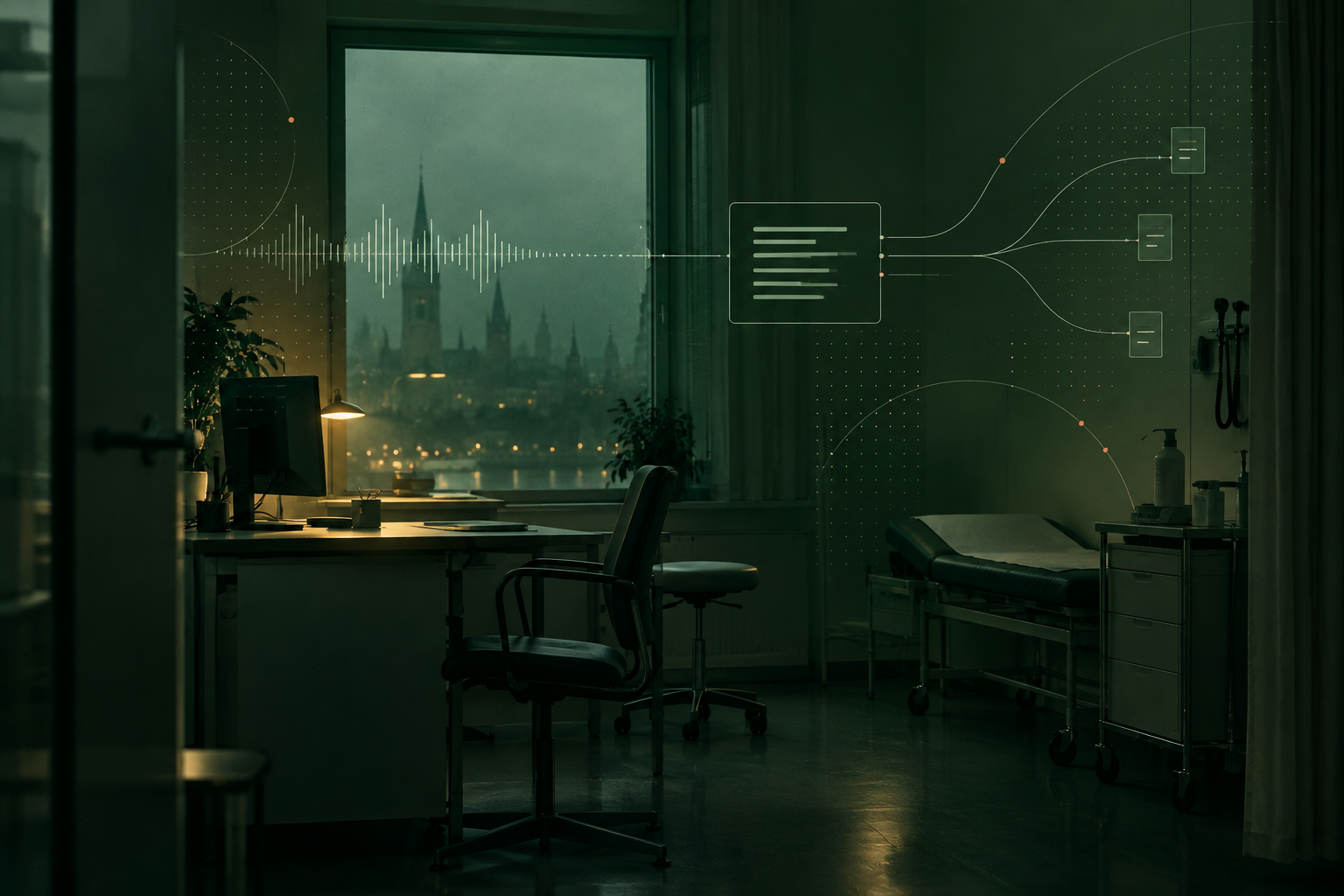
The Swedish Data Protection Authority, IMY, has opened supervision of Region Gävleborg over its use of AI-based transcription in primary care [1]. The region has been using AI tools to help doctors save time by transcribing consultations, but the supervision asks how patient data is handled in that process.
IMY's questions centre on storage and processing: where the data goes, who has access to it, and whether it is handled in line with Swedish patient data law and the GDPR [2].
It's a bit like handing someone your diary at the doctor's: saving time is good, but you'd want to know where it ends up and who reads it.
What the rules say
Under Swedish patient data law (Patientdatalagen), healthcare providers must keep patient records, and entries must be signed by the person responsible for them [3]. Access to records must also be documented [3].
The GDPR adds two layers. First, personal data must be limited to what is necessary (data minimisation) [4]. Second, it must be protected against unauthorised alteration and access [4].
When an AI transcribes a consultation, patient data is being processed. The question IMY is asking is whether that processing follows the rules: is the data minimised, is access logged, and are the records kept in a way that meets the requirements?
The time-saving promise
AI transcription tools promise to cut the administrative burden on doctors. Instead of typing up notes after each consultation, the doctor speaks, the AI transcribes, and the doctor signs off on the result.
That's a real gain if it works. Doctors spend a lot of time on documentation, and less time typing means more time with patients.
But the promise depends on trust: trust that the transcription is accurate, that the data stays secure, and that the record kept in the journal system is the one the doctor approved.
The evidence gap
Here's where it gets tricky. A journal entry is signed by the doctor, but what if someone later questions whether the entry was changed after signing? Or whether the version the AI transcribed matches the version that ended up in the record?
Patient data law requires signed entries and documented access, but it doesn't say how to show that an entry hasn't been altered since it was signed [3]. That matters when trust is questioned.
A log its keeper can quietly edit is harder to defend than one where any change shows up. When the question is whether a record has been tampered with, the side without independent proof starts on the back foot.
What this means for you
If you're a healthcare provider using AI transcription, or thinking about it, IMY's supervision is worth watching. Here are three questions to ask now:
- Where does the patient data go during transcription, and who has access to it?
- Can you show, if asked, that a signed journal entry hasn't been changed since the doctor signed it?
- Are access logs themselves protected in a way that holds up if they're questioned?
The supervision is ongoing, so there's no ruling yet. But the questions IMY is asking are the ones every provider will need to answer sooner or later.
How a digital witness would work here
The thing to seal in a case like this is each signed journal entry, at the moment the doctor signs it. You seal a fingerprint of the entry, not the entry itself, so the content never leaves your systems.
If the entry is questioned later—say, a patient's representative asks whether it has been changed—anyone you share the record with can calculate the fingerprint again and check it against the sealed one. If it matches, the entry is unchanged. Change a single character and it won't match.
A digital witness also works for access logs. Seal log segments at short intervals, and you can show that the log of who accessed a patient's record is exactly what was written at the time.
What it doesn't do is replace the journal system, decide who may access what, or show that the transcription was accurate. It shows that the entry and the log haven't changed since they were sealed, which is a different question—and in a supervision like this, a helpful one to be able to answer.
To get started, your journal system sends a fingerprint of each signed entry to WitniumChain through the REST API, the SDK or the MCP server, and gets a witness ID back. The content stays with you. The first 2,000 witnesses a month are free. Read the docs for the technical details.
How it would work
- Doctor signs the journal entry.
- The journal system seals a fingerprint of the signed entry.
- If the entry is questioned later, anyone you share it with can check that it hasn't changed since signing.
What to watch
IMY's supervision is ongoing, and the outcome will shape how healthcare providers think about AI transcription and patient data handling.
Beyond this case, the AI Act's rules for high-risk AI systems will apply to medical devices from 2 August 2028 [5]. Software that counts as a medical device under the Medical Devices Regulation will also count as high-risk AI if it uses AI techniques [5].
That means quality management, clinical evaluation and post-market surveillance, with logs and records that need to hold up under scrutiny [6].
For now, the question in Gävleborg is simpler: when an AI helps a doctor save time, can the healthcare provider show that patient data was handled according to the rules?
Sources
- [1]Facebook post by Zarah Öberg about IMY supervision, Facebook, 2026
- [2]Regulation (EU) 2016/679 (GDPR), EUR-Lex, 2016-04-27
- [3]Patientdatalagen (2008:355), Riksdagen, 2008
- [4]GDPR Article 5 (Principles) and Article 32 (Security), EUR-Lex, 2016-04-27
- [5]AI Act implementation timeline, European Commission AI Act Service Desk, 2024
- [6]Regulation (EU) 2017/745 on medical devices (MDR), EUR-Lex, 2017-04-05