
Sector · HR and recruitment
Cases · 2026-10-21 · 5 min read
US judge allows AI hiring discrimination claims against Workday to proceed
A federal judge has ruled that key allegations of algorithmic bias in Workday's recruitment software can go forward, including claims that the system screened out older applicants and Black candidates. The company denies the allegations. For employers, the case underscores a practical problem: proving what your hiring AI actually did.

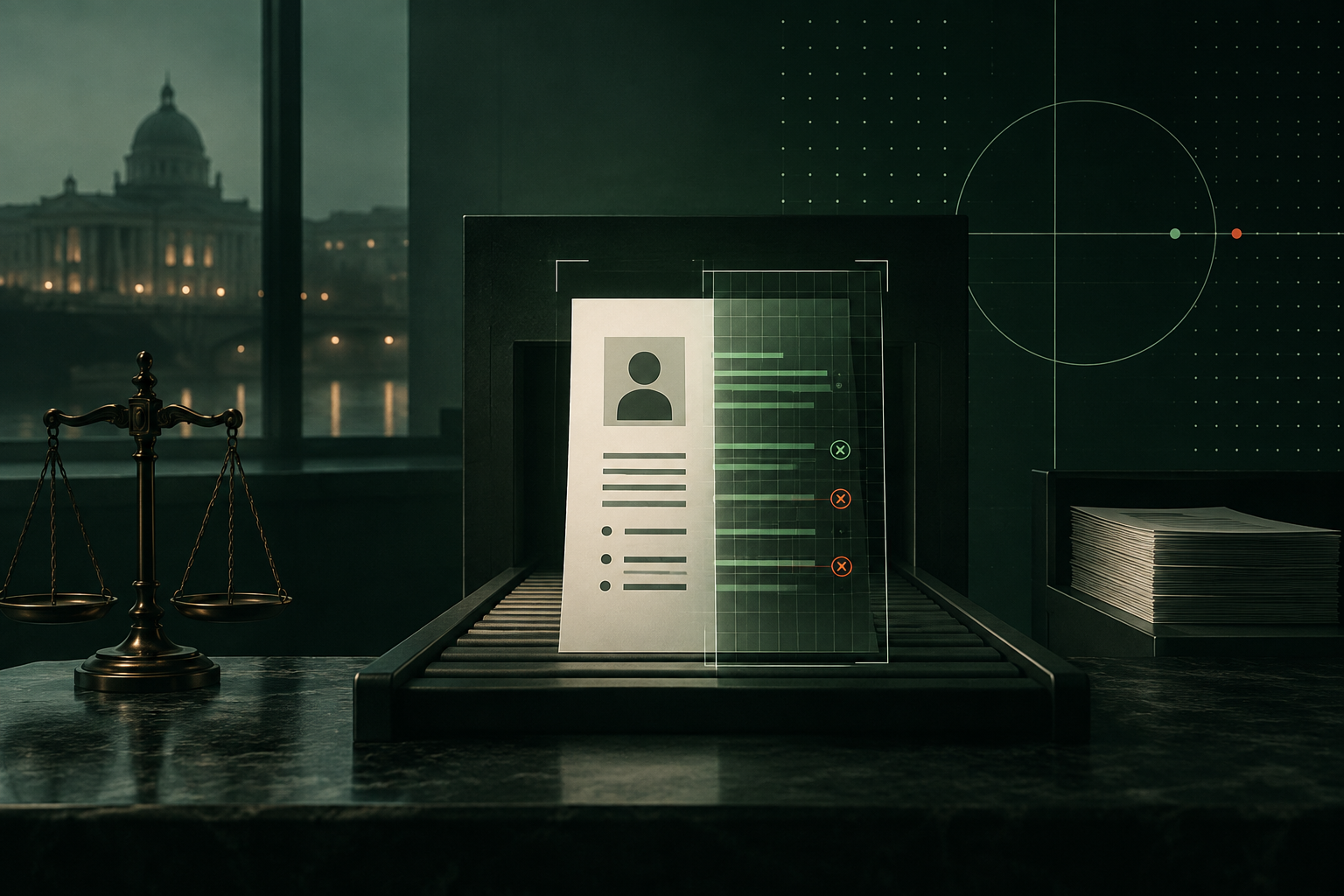
On 10 January 2025, a federal judge in California allowed several claims to proceed in a proposed class action against Workday, alleging that its AI-powered recruitment software discriminates against older job seekers and Black applicants [1]. Workday has denied the allegations, and the court has made no finding on the merits [2]. The decision means the case will continue.
The plaintiffs claim that Workday's screening tools automatically rejected their applications based on factors that correlate with age and race, and that the company should have known its algorithms could produce biased results [1]. Workday maintains that its tools are designed to reduce bias, not cause it, and has said it will defend the claims [2].
For anyone running AI in recruitment, the interesting question is not who will win, but what either side would have to prove. Say an applicant rejected two years ago claims the system scored them unfairly. The applicant has their rejection email. What does the employer have? A log entry saying the model gave a low score is one thing. Being able to show which model version ran, what it scored, which human reviewer saw it and that nobody has quietly edited the record since is another.
It is a bit like a disputed restaurant bill. The customer has the receipt. The restaurant needs to show what was actually rung up that evening, not what the till says now.
What the law asks for
From 2 December 2027, AI used to select, screen or evaluate candidates for employment counts as high-risk under the EU AI Act [3]. The requirements are specific. Article 12 says the system must technically allow for automatic logging of events over its lifetime [4]. Article 86 gives affected individuals the right to a clear explanation of the AI's role in decisions with legal or similarly significant effects [5].
In the US, there is no equivalent federal AI regulation yet, but employment discrimination law has been around for decades. When a system screens thousands of applicants and someone claims it treated them unfairly because of age or race, the employer may have to show what the system did and why. That often means producing the algorithm's decision record, the training data and sometimes the model itself.
The challenge is that logs are kept by the same people who built or bought the system. In a dispute, the other side will ask whether the log could have been changed. It is a reasonable question. A log you can edit is a diary. A log you can prove hasn't changed is evidence.
How a sealed decision log would work in recruitment
Say a company screens 5,000 applications a month with a model that scores CVs and passes high scorers to a human reviewer. The thing to seal is each screening decision as it is written to the log: the candidate reference (never their name or protected characteristics), the model version, the score and which reviewer saw it.
Sealing takes a fingerprint of the record, not the data itself, so the decision never leaves the company's systems. The fingerprint is sealed on WitniumChain documentation, where any later change would show. If a decision is questioned a year later, the company calculates the fingerprint again. If it matches, the record is exactly what was written on the day. Change a single character in the log and it won't match.
Anyone the company shares the record with—an auditor, a lawyer, a regulator—can run the same check. It doesn't require anyone to trust the company's IT department or take its word that the backup is clean.
How it would work
- Each time a candidate is screened, the system writes a decision record and seals a fingerprint of it.
- The fingerprint goes to WitniumChain through the REST API, the SDK or the MCP server. The record itself stays with you.
- When the decision is questioned, you calculate the fingerprint again and compare it with the sealed one.
The first 2,000 witnesses a month are free.
What sealing doesn't do
A sealed log shows that a record hasn't changed. It doesn't show that the model was fair, that the training data was representative or that the decision was lawful. Those are separate questions, and harder ones. But they are easier to answer when the other side can see that the record you are relying on is the one written at the time, not one edited afterwards to make you look better.
Sealing also doesn't replace the logging itself, or human oversight, or testing for bias before the system goes live. It is a way of making the log harder to challenge, not a way of avoiding the logging duty or the fairness question.
What this means for you
If your organisation uses AI to screen, rank or assess job applicants, or plans to, here are three questions worth asking now:
- Could you show, a year from now, which model version screened a particular applicant, what it scored and which person reviewed it?
- Is that record kept in a way that would hold up if someone claimed it had been changed?
- Who in your organisation can edit the logs, and would an auditor or a court take your word that they didn't?
From 2 December 2027, if the system counts as high-risk under the EU AI Act, logging becomes a legal requirement [4]. Being able to show the logs haven't changed is not explicitly required, but it is hard to see how a log anyone could edit would satisfy a regulator or survive a dispute.
What to watch
The Workday case will take time to resolve, and the company denies the allegations. Regardless of the outcome, it is a reminder that algorithmic decisions about people tend to get questioned, often long after they were made.
In the EU, the clock is running. High-risk AI for recruitment must meet the logging and transparency requirements from 2 December 2027 [3]. In the US, the regulatory picture is less clear, but employment law already gives applicants ways to challenge decisions they believe are discriminatory.
For any organisation, the practical question is the same: when someone asks what your AI did, and whether the record can be trusted, what will you show them?
Sources
- [1]Order Granting in Part and Denying in Part Motion to Dismiss, Mobley v. Workday, Case No. 3:23-cv-00770-RS, United States District Court, Northern District of California, 10 January 2025
- [2]Workday Statement on Mobley v. Workday, Workday, 13 January 2025
- [3]The implementation timeline of the EU AI Act, European Commission AI Act Service Desk, Accessed January 2025
- [4]Article 12, Regulation (EU) 2024/1689 (AI Act), European Commission AI Act Service Desk, Accessed January 2025
- [5]Article 86, Regulation (EU) 2024/1689 (AI Act), EUR-Lex, Accessed January 2025