
Sector · Legal
Cases · 2026-11-02 · 5 min read
AI deepfakes are getting too real for courts to catch, OpenAI and Meta warn
OpenAI and Meta told federal judges in Boston that AI-generated deepfakes now look so convincing that courts risk treating fake evidence as real. The warning points to a growing problem: when AI can create flawless forgeries, how do you prove what actually happened?

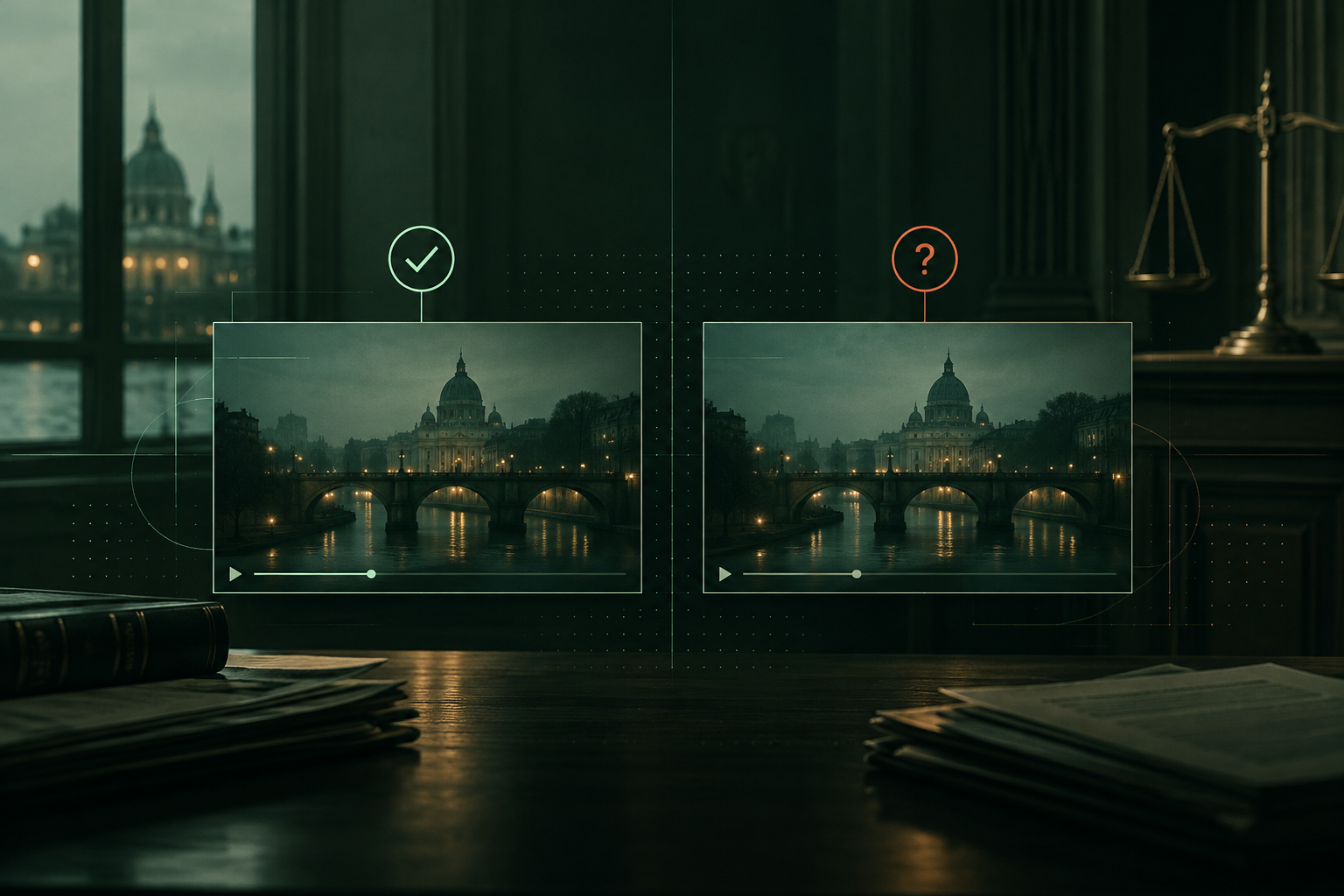
When a fake looks flawless
OpenAI and Meta recently told federal judges in Boston something most people outside courtrooms haven't fully absorbed yet: AI-generated deepfakes are so good now that even experts struggle to spot them [1]. The technology has crossed a line. A deepfake used to mean a clumsy face-swap or robotic-sounding audio. Now it means a video of someone saying something they never said, in their own voice, with their own face, lit and framed exactly as a real recording would be.
That's a headache for anyone, but it's a crisis for courts. Evidence is supposed to settle disputes. A photo, a recording or a document shows what happened, and the parties argue over what it means. But when the thing itself can be a forgery good enough to fool a judge, the whole method breaks.
Think of it like this: a bank note has watermarks and threads woven into the paper, so you can check it against the light. A deepfake has nothing of the sort. It looks and sounds exactly like the real thing, because the AI that made it learned from thousands of real things. Strip the metadata, run it through a couple of apps, and even the people who built the model can't always tell you whether it's genuine.
What the AI Act says about deepfakes
The EU saw this coming. Article 50 of the AI Act, which has applied since 2 August 2026, says that anyone using AI to create or manipulate image, audio or video that forms a deepfake must disclose that the content is artificially generated or manipulated [2]. A deepfake, under the regulation, is content resembling real people, objects, places or events that would falsely appear authentic [3].
The rule is clear, but it has two limits. First, it applies to the person deploying the AI, not to whoever receives or shares the content afterwards. A disclosed deepfake can lose its disclosure as it spreads. Second, disclosure is not detection. Knowing that deepfakes exist doesn't tell you whether the video in front of you is one of them.
For courts, that matters. A piece of evidence doesn't come with a label saying "this is real" or "this was made by AI". It comes with a claim: this recording shows what my client said, this photo shows the damage, this document is the contract we signed. The other side challenges it or doesn't. If they do, the court has to decide.
The problem detection can't solve
For years, the answer to forgery was forensics. You examined the file, looked for traces of editing, checked whether the metadata matched the story. That still works for sloppy fakes, but the technology has moved faster than the methods.
OpenAI and Meta's warning to the judges was direct: detection tools are struggling [1]. An AI trained on millions of real images knows what a real image looks like in every detail, down to the way light scatters and skin compresses. It doesn't leave the rough edges earlier tools did. Some researchers are working on detectors trained to spot AI signatures, but it's an arms race, and the forgers are ahead.
That puts courts in an awkward position. Faced with a contested video, what do you do? Send it to a lab and wait for an expert report that says "probably real" or "we can't tell"? Ask the party that produced it how they know it's genuine, and hope they kept good records?
The deeper issue is this: if you can't reliably detect a fake, you have to start from the other end. Instead of asking whether something looks real, you ask whether it can be shown to be real. That means records, and it means they have to be records nobody could have quietly edited along the way.
What this means for you
If you work somewhere that might one day need to prove what was said, shown or recorded, a few questions are worth asking now:
- When you capture a photo, video or document that could become evidence, do you have a record of when it was captured and that it hasn't changed since?
- If someone challenges a recording your organisation produced, could you show a court the original file, when it was made and that nobody has altered it?
- For customer-facing AI that generates content or answers questions, do you keep a record of what it produced, separate from anything the customer might keep?
- If a deepfake of your CEO giving instructions turned up, how would you prove it's fake?
The courts will keep working with what they have, but the parties that can back their evidence with something checkable will have an easier time.
How a witness makes a recording checkable
This is where sealing at capture makes a difference, and it's concrete enough to see how it would work.
Say you're filming an interview, taking site photos or recording a call that could be disputed. At the moment of capture, the device or software takes a fingerprint of the file—a string of characters that changes completely if even one pixel or one frame is altered—and sends that fingerprint to WitniumChain [4]. The file itself stays with you. The chain records the fingerprint and the time, and gives you a witness ID.
Months later, someone questions the recording. You share the file, the witness ID and the verification link. They calculate the fingerprint from the file you gave them and check it against the one that was sealed. If it matches, the file is exactly what was captured that day. Change a single frame and it won't match.
What it shows: that the file hasn't been edited since capture, and when it was captured.
What it doesn't show: whether the content is what someone says it is. It doesn't prove the person in the video said those words willingly, or that the photo shows what the caption claims. It just shows that the file is unchanged.
For courts trying to separate real evidence from flawless fakes, that's a start. It shifts the question from "does this look real?" to "can you show it was captured when you say it was, and that nobody has touched it since?"
How it would work
- At capture: the app or device takes a fingerprint of the recording and seals it.
- At verification: anyone you share the file with calculates the fingerprint again and checks it against the sealed one.
- In court: you can show that the file is exactly what was captured, unchanged.
You can seal photos, video, documents and AI outputs through the REST API, the SDK or the MCP server. The content never leaves your systems. The first 2,000 witnesses a month are free [4].
What to watch
The disclosure duty under Article 50 is being enforced, and the European AI Office has published guidance on what counts as adequate disclosure for deepfakes [5]. Courts in several member states are starting to ask parties how they know a recording is genuine, particularly when it's contested.
Meanwhile, the technology is still moving. The gap between what AI can create and what forensics can detect is widening, not closing. For anyone who might one day need to prove what was recorded, the time to think about how you'll do that is before someone asks.
Sources
- [1]AI Deepfakes Are Getting Too Real For Courts To Catch, OpenAI And Meta Warn, Yellow.com (reporting on testimony to federal judges in Boston), 2024
- [2]Article 50, Regulation (EU) 2024/1689 (AI Act), European Commission AI Act Service Desk, 2024
- [3]Article 3(60), Regulation (EU) 2024/1689 (definition of deepfake), European Commission AI Act Service Desk, 2024
- [4]WitniumChain Documentation, Witnium, 2026
- [5]Guidance on transparency obligations under Article 50, European AI Office, 2026